Relations between an artist and a distributor
Signing a contract with a distributor or a label — great! Read the contract before signing and know your rights — high-level. And yet, most often artists, in a fit of excitement, sign contracts without looking. Or they do look, try to get into it, but don’t really understand what’s what.
To avoid running into harsh restrictions on rights and unpleasant surprises in a production agreement, read my new article.
This scheme will help you understand the relationships between the artist, label, distributor and streaming services faster.
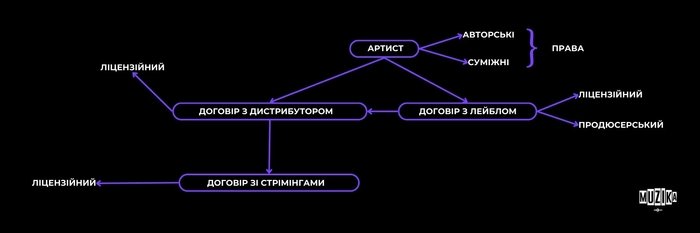
Licensing and production agreements: differences
Each participant in music production has their own rights. They depend on how the artist and the company chose to cooperate at the first stage and what agreement they entered into.
A label enters into licensing and/or production agreements.
If it is a licensing agreement — you transfer to the label the rights to use individual units of your content (a single or an album). In the case of a production agreement, the label gets the rights to use all songs together. (but everything is individual; let’s read the contract and negotiate).
It is important to understand! You, and only you, are interested in defending your position and protecting yourself, so when drafting a contract without a lawyer, there is a risk of getting caught out by wording that could put you in an awkward position. Contact a lawyer. I have trusted ones I’m confident in, so I’ll help if needed. The permission to use songs can be exclusive or non-exclusive.
Let’s break it down:
Exclusive license — this is when the author can transfer the rights to use a track to only one party (a label or a distributor).
Non-exclusive license — this is when the author transfers the rights to use the music to many persons. For example, this is convenient in synchronization. That is, the artist themselves, their label and/or manager can negotiate placing tracks in film and advertising.
Both licensing and production agreements have their own risks and advantages. Each scheme affects the artist’s rights in its own way. And what rights are there at all?
Everyone has their own rights: distributor, artist, streaming
First, let’s look at the artist. First and foremost, they have copyright. It opens the door to monetizing tracks on streaming services. Moral rights and exclusive rights are distinguished.
Moral rights confirm that the artist is the author of the song. They cannot be bought or sold. These rights remain with the author forever. And there is one more important point. Sometimes moral rights can protect the artist’s name, because they extend to the pseudonym.
Exclusive rights are even cooler. They allow authors and rights holders to benefit from the work: sell it, enter into licensing agreements, receive royalties, etc. Exclusive rights may arise for the artist after the rights have been assigned by the original author of the track.
I should note from practice that some songwriters are deeply hurt when, after the assignment, they are no longer credited among the song’s creators.
In addition to copyright, the artist has neighboring rights: to the performance and the phonogram of the track. Yes, if the artist themselves plays an instrument or sings on the recording, they have performance rights. If they personally paid for the recording, then phonogram rights arise. It is precisely these rights that the artist shares with distributors and labels when cooperating in order to get onto streaming services.
Thus, the artist’s neighboring rights to the performance and phonogram of the track are transferred to distributors or labels after concluding licensing or production agreements. This is how the artist allows the label/distributor to upload their songs to streaming platforms.
Sometimes, during such transfers, rights to albums disappear from the artist altogether. Even if they entirely created the composition and lyrics themselves. This happened to Taylor Swift. The singer lost part of the rights to the 2012 album Red and fell out with her former label Republic Records.
This situation caused a wide public and media outcry. In 2021, after the pandemic, Taylor decided to re-release the album so that the master rights would definitely belong to her. It turned out super successfully! Within one day, Red tracks on Spotify were streamed 122.9 million times, and the 10-minute version of All Too Well is preparing to break a Billboard record. So even terrible stories can be turned to your advantage.
How distributor, label and streaming services work together
The long route.
Artist → Label → Distributor → Streaming services
The label can provide distribution of tracks to the artist. To do this, the label establishes partnerships with a distributor. For example, this is how Muzika Agency works. In addition to the agreement with the artist (licensing or production), we have a licensing agreement with the distributor Independent Digital. Under this agreement, we also transfer neighboring rights to use the phonogram, etc., so that the artist’s music can be released on streaming.
The short route.
Artist → Distributor → Streaming services
There is another option for an artist to get onto streaming — directly through a distributor or aggregator such as TuneCore, CD Baby, OneRPM.
In turn, the distributor enters into a direct licensing agreement with the streaming platforms. It gives the platform the right to host the music and provide access to it by subscription.
It may seem that the long route is worse because it has more links. But that is not the case at all. The terms for labels with distributors are more favorable than for direct artist submissions. After all, labels bring companies-distributors a large number of performers at once. This practice is beneficial for companies, and that is why they usually prioritize releases from label artists.
The label team is also prepared for force majeure situations that may occur along the song’s path to streaming platforms. There is experience and an understanding of how to communicate with the distributor in order to resolve the situation quickly and efficiently.
Independence
In any case, the contract you sign, whether with a label or a distributor, has a term: one year / three years, etc. This is normal, as it provides certain guarantees for the parties that work will be carried out during the specified period and the result will accumulate in the form of monetary remuneration.
But in most cases, there is an opportunity to adjust the clauses of the contract relating to the percentage rate of remuneration, terms, territorial distribution of the release (so as to exclude those countries in whose territory you do not wish to be heard), etc.
The standard revenue share between a distributor and a label at the start of the partnership is 30/70; sometimes, exclusively, the distributor may offer the label 20/80 from the outset of the partnership and then further reduce it as the volume of a quality catalog grows. In turn, when dealing with an artist, the distributor will most likely not offer a lower rate unless you have truly large volumes of plays in the catalog, measured in millions and tens of millions of streams.
Important! A label or distributor will not be able to take away the rights to and ownership of the catalog from the songwriter / artist unless the songwriter / artist themselves provide legally confirmed permission for this. By analogy, it is like owning a business and its assets. The business owner chooses a trusted partner and decides whether to share ownership and a share of net profit with that partner, or not, and limit them to defined boundaries.
Author: Pavlo Striletskyi
Author: Pavlo Striletskyi