UASP for authors: how to receive royalties and register songs
Public Organization “Ukrainian Agency for Copyright and Related Rights” is the first copyright management organization in Ukraine to be recognized internationally.
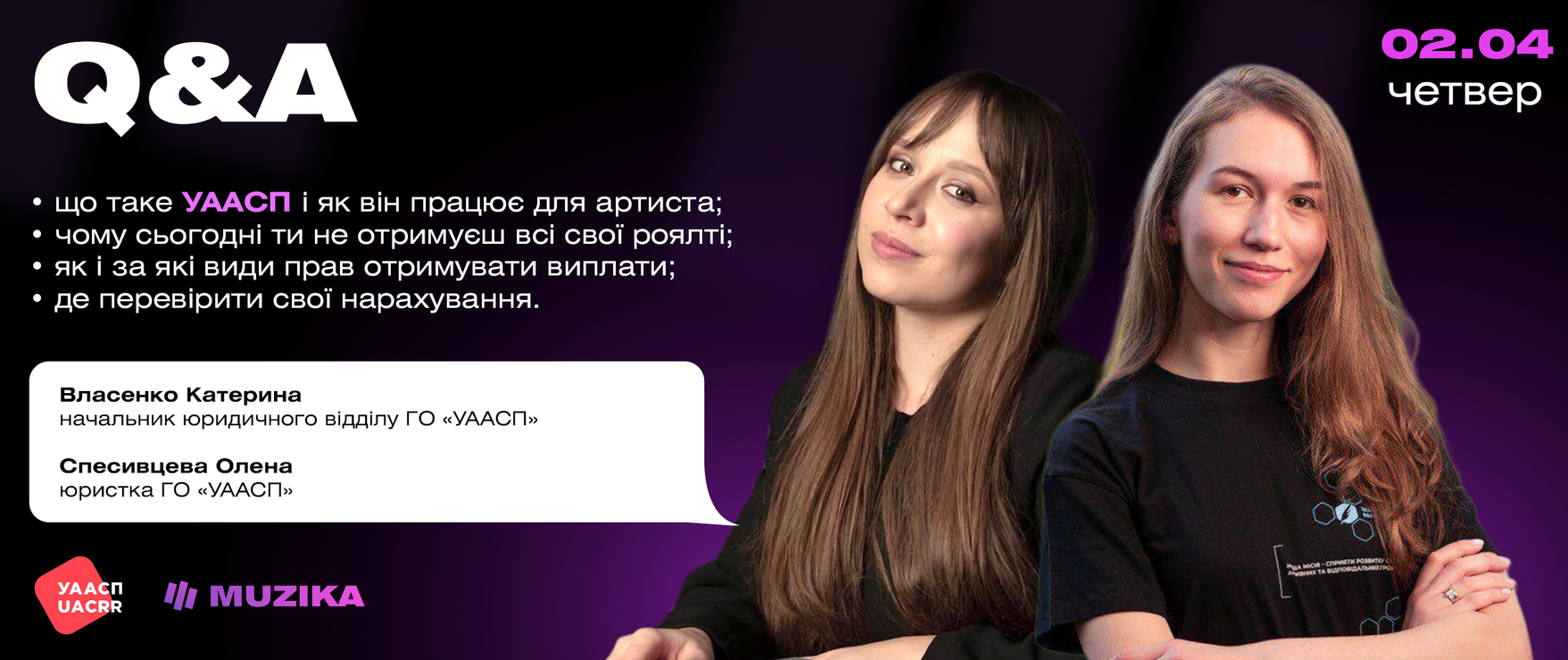
Summary of the online meeting dated 02.04.2026
Author’s royalty vs fair remuneration
Many people confuse these terms, but these are two different streams of money:
- Author’s royalty — for the use of the musical work itself (lyrics and melody).
- Fair remuneration — for the use of the phonogram in which the work is fixed.
Important: Fair remuneration is a separate payment. If a user pays UAH 100 in authors’ royalties, they additionally pay UAH 50 in fair remuneration, which is split 50/50 between performers and the phonogram producer.
💡 Must-know: Fair remuneration is inalienable. You cannot transfer it to the label or waive it in a contract — the law always reserves this right for the artist.
Does UASP collect fair remuneration, or only authors’ royalties?
As of now, UGO “UASP” operates within the framework of voluntary collective management established by the Law of Ukraine “On Effective Management of Property Rights of Rights Holders in the Sphere of Copyright and (or) Related Rights.” Under this model, the organization manages only those copyright property rights that are transferred to it directly by authors.
UASP collects author’s royalty only for those works that authors have transferred into management. In other words, royalty collection is limited to a specific catalog of works for which the relevant agreements have been concluded with rights holders.
This model is new for Ukraine, since previously collective management organizations mostly operated under the system of mandatory collective management.
Under mandatory collective management, CMOs collect remuneration for the use of works of all authors regardless of the existence of agreements. Payouts are made to those rights holders with whom agreements have been concluded, while other rights holders are subject to identification (they are being sought).
After accreditation, CMOs will have the right again to collect remuneration for all authors regardless of whether their works are included in the organization’s catalog, which is the key difference from voluntary collective management.
Separately, the law establishes the obligation of CMOs to collect fair remuneration for the use of phonograms in which works transferred into management are fixed. At the same time, author’s royalty and fair remuneration are different types of payment.
Fair remuneration is distributed not among authors, but between performers and phonogram producers.
Do the author and the phonogram producer need to sign separate agreements in order to receive remuneration?
Yes, the author and the performer/phonogram producer interact with the CMO on different legal grounds, so the procedure for formalizing the receipt of remuneration differs.
To receive author’s royalty, the author acts on general terms: they transfer their property rights into the management of the collective management organization by concluding the relevant agreement. Such an agreement authorizes the CMO to collect, distribute, and pay royalties for the use of their works.
As for fair remuneration paid for the use of phonograms, the mechanism is different. In this case, UASP independently searches for performers and phonogram producers. After these persons are identified, they submit declarations specifying their shares in the phonogram and conclude an agreement with the CMO to receive fair remuneration.
When does an author need to register a work with UASP?
Before release, immediately after creation. If you register later, there is a risk of losing royalties for the period before registration.
The organization accrues money only for works that are already in the catalog. If you remember to register six months after the song becomes a hit, you risk losing royalties for the entire period.
The ideal sequence:
1. Wrote a song.
2. Registered it with UASP (online via EDS).
3. Released the track.
Can you come six months or a year later and get the money retroactively?
The possibility of receiving remuneration retroactively six months or a year later exists, but only in certain cases and is not guaranteed.
If the author was not previously registered with the organization that collects author’s royalties from digital platforms, each case is considered individually.
In theory, payment is possible if the work was not registered with other organizations and is present in usage reports that arrived late. In such a case, additional remuneration may be accrued.
At the same time, if the work was already under the management of another organization, a conflict may arise regarding the remuneration collection period, which complicates or makes payment impossible.
In general, such cases are exceptions, so it is recommended not to delay transferring rights into management in order to avoid losing income.
Is there any point in registering with several CMOs at the same time, for example BMI and UASP?
Yes, you can register with several CMOs, for example UASP and Broadcast Music, Inc..
But it all depends on where your works are used. If your main market is Ukraine, it is easier to work through UASP.
Especially since remuneration from foreign CMOs usually comes to UASP under reciprocal representation agreements, and UASP then pays the author.
Therefore, for convenience, less administrative burden, and to avoid confusion with payouts, it is usually enough to work through one organization, especially if that is UASP.
What are the risks if an author is registered both in Ukraine and abroad?
If an author is simultaneously registered with a Ukrainian CMO, such as UASP, and a foreign one, such as BMI or PRS for Music, this can lead to double commission deductions. Each organization administers rights and retains its own percentage, so when remuneration passes through several CMOs, the author’s actual income may decrease.
There is also a risk of repertoire conflict between local CMOs if works in the territory of Ukraine are assigned to several local CMOs, when the same work or a share in it is declared with different organizations. In such a case, several CMOs may simultaneously claim rights to one work, which often leads to payments being blocked until it is clarified who exactly has the authority.
The administrative burden also increases significantly, as the author has to interact with several accounting systems, submit work data to different CMOs, monitor the accuracy of the information, and respond to each organization’s requests.
It should also be taken into account that payments may arrive with delays, since international settlements between CMOs take a long time and require additional checks.
In addition, tax and currency issues arise, as different countries apply different tax rules, which can make receiving income more complicated and require additional administration.
In the end, this model is possible and is often used for the international exploitation of works, but it requires a clear division of powers, alignment of contract terms, and constant oversight by the author.
How can an author check whether royalties are being calculated correctly?
Through reporting and the author’s account, which UACR has already launched. If there are doubts, you can contact UACR and request a report on the use of works.
Why might an author receive less than they are owed?
Main reasons:
- the work is not registered with the CMO;
- the user (cafés, bars, restaurants, etc.) submitted an incorrect report;
- there is a dispute between co-authors;
- the work is being used, but the author is not tracking it;
- there are delays in reports from platforms.
How does UACR work with distributors?
UACR and a distributor are different entities.
It is necessary to distinguish monetization from royalties:
- Monetization is what you receive from the distributor for streams.
- Royalties are remuneration for public performance or communication to the public (radio, TV, background music in shopping malls).
UACR already works with Apple Music, Spotify, and TikTok, collecting the author’s share directly from the platforms.
The distributor helps place music on digital platforms and collect monetization, while UACR collects royalties for the use of works. A technical integration between muzika.ua and UACR is currently being prepared so that data submission will become even less bureaucratic.
Do you have to pay the author for the reproduction of their work in a non-commercial project?
Yes, even in a non-commercial project, the use of a work requires the permission of the rights holder and, as a rule, involves the payment of remuneration. The mere absence of profit does not exempt one from licensing.
At the same time, the key decision always remains with the author: they may allow use free of charge, set remuneration, or define other terms.
Does UACR collect royalties for Christian artists?
Yes. Christian songs are not separated from other musical works. If they are in the catalog and are used on radio, digital platforms, or in other permitted places, royalties are collected in the same way.
Can fair remuneration be waived in a contract?
No. It is inalienable. If a contract states that someone waives it or transfers it to another party, such a clause will be null and void.
How are rights divided in a band between music, lyrics, and arrangement?
There is no universal formula. The best approach is to agree before the work is created and record the percentages in writing. If there is no agreement, it is very difficult to prove later.
Why does an author sometimes receive no payments from Ukraine but does from abroad?
Most often due to delays in reports from digital platforms (2 years) or because use in Ukraine has not yet made it into reporting. If the author sees their tracks being used in Ukraine, they should notify UACR about it.
What obligations arise for the author after signing a contract with UACR?
Main:
not to waive the author’s remuneration;
to notify about changes to their contact details and payment details;
where possible, to track the use of their works and report infringements.
Can co-authorship be proven after release if the documents were not previously formalized?
Yes, but it is more difficult. Evidence is needed: correspondence, video or photos from the studio session, project files, metadata, drafts, agreements. Without written records, proving rights is much harder.
If a song is released in several languages, how should it be registered?
UACR advises registering the work and then distributing it through international databases. If it is clear that usage is greatest in a certain country, one can separately consider territorial rights management.
Practical conclusions:
Use the author’s account. UACR launched a convenient account, where you can view reports online.
Written contracts are fine. Formalize relationships with sound producers, vocalists, and designers.
Monitor reports. If you know a song was in rotation but it is not in the report, write to UACR.
📩 How do you become an UACR author?
You need to contact the organization’s managers, obtain a standard contract, and sign it (you can do so via Diia.Signature). Contacts and document templates are on the UACR website.
Author: UACR NGO