Songwriting Without Waiting for Inspiration: Notes from a Meeting with Anna Petrovska
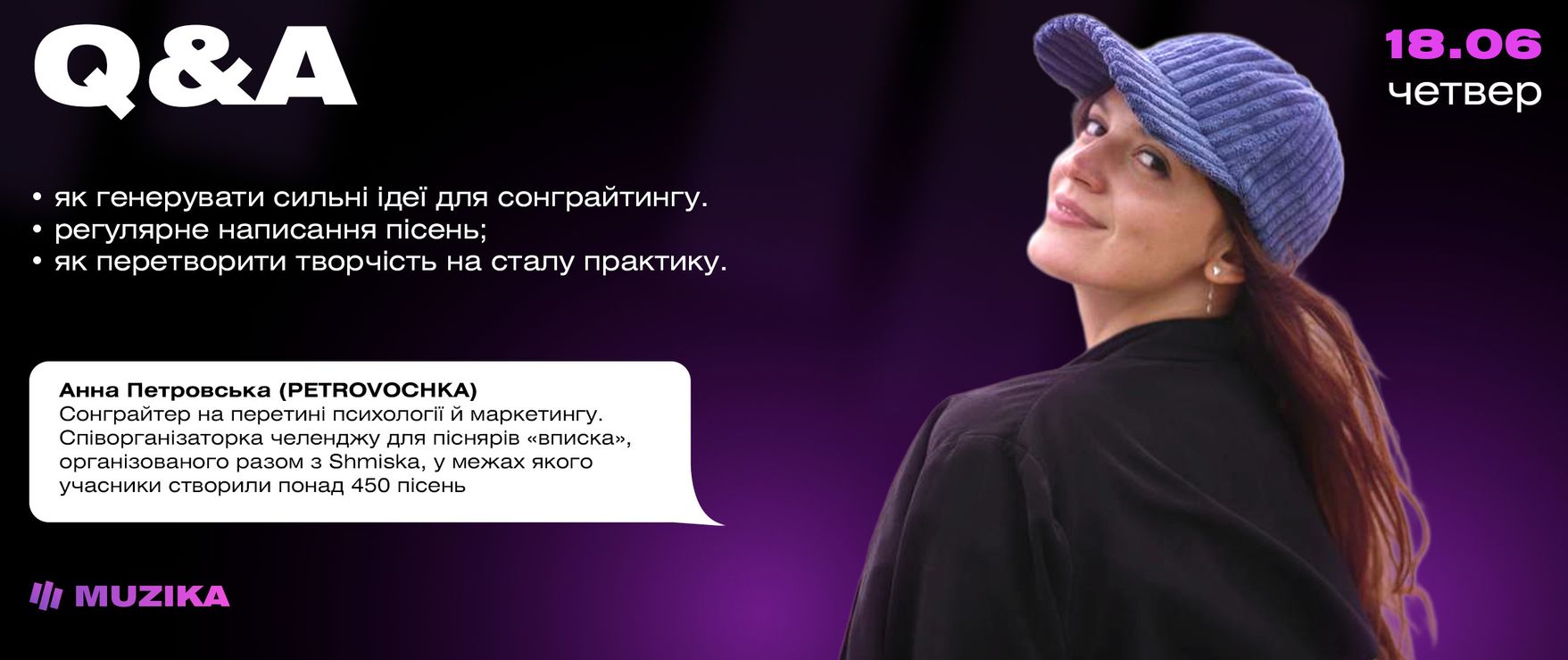
Anna Petrovska – songwriter at the intersection of psychology and marketing 🧠 co-organizer of the songwriters’ challenge “vpiska,” organized together with Shmiska, within which participants created over 450 songs
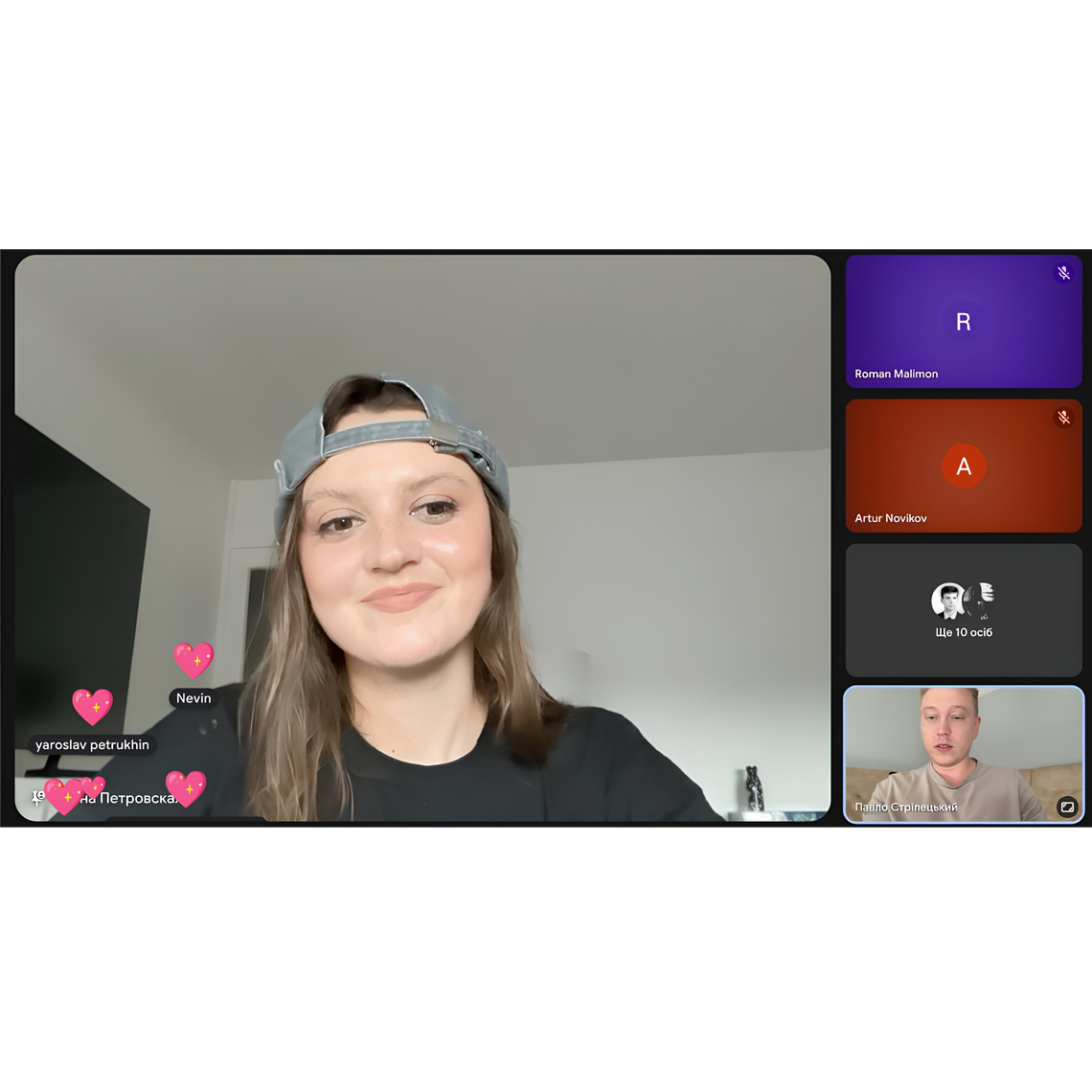
Notes from the online meeting of 18.06.2026
What Is Inspiration and Should You Wait for It?
According to Anna, you should not wait for inspiration as a condition for work.
There are two types of inspiration:
Primary inspiration — when you’re “hit” by emotion, a flow state, or a powerful life experience.
Secondary inspiration — when ideas come not only from your personal state, but from the surrounding world: phrases, conversations, news, books, series, comments, random observations.
Should you wait for it?
No. Her position is simple: don’t wait for inspiration, sit down and work. She emphasized that most good songs are born not from a “magical state,” but from regular practice, discipline, and attentiveness to the ideas around you.
Where do ideas for new songs come from?
Anna advises looking for ideas not only within yourself, but also in the outside world — literally “under your feet.” They most often come from:
- conversations and random phrases
- comments on social media
- films and series
- books
- news headlines
- observations of everyday life
- images, characters, objects
She also stresses that it is important to work with two lenses:
- internal — what am I experiencing right now, what message do I want to convey
- external — what do I see around me, what ideas can I pick up from the context
To gather ideas, she recommends keeping a separate notebook or notes on your phone and writing down words, phrases, images, associations there.
Anna’s Path to a Systematic Approach to Songwriting
You can write not only about yourself, but also from another perspective — from a character, an object, or a situation, not just from your own experience.
Anna set herself a creative challenge
She was inspired by the example of Izdryk, who writes a piece of a poem every day, and decided to do the same with songs.
Started a daily practice
At first, it was an ambitious year-long challenge within which she wrote many songs, and one of them later became a successful release.
Started consciously collecting ideas, separating two modes:
- the creation mode;
- the idea-gathering mode. For this, she writes down words, phrases, images, and perspectives in a notebook.
You shouldn’t be “too much” in one state. When you write — you write. When you’re not writing — you observe, listen, and accumulate material.
That is, it’s not necessarily a finished song topic. More often, they are small “hooks” from which you can later put together lyrics or a topline.
She separately emphasized that she likes to capture exactly what can become song material: something heard in conversation, an interesting word, an unexpected image, or a new perspective on a topic.
How do you bring a song to completion if a creative pause appears?
Anna recommended several practical ways when a song gets “stuck”:
- Reread what you already have and ask yourself: what would I say next if this were an ordinary conversation?
- Make a mind map / associative list around the topic.
- Visualize the scene: what else is in this picture besides what has already been written?
- Ask yourself “what if…” — this opens up space for unconventional moves.
- Change the perspective: if it doesn’t work from one character, try another perspective.
Anna’s main idea: if the pause drags on, you don’t need to force yourself — sometimes it helps to simply return to the material from another angle.
Anna used the “what if…” technique as a way to move a song forward and open up a new creative space.
The essence of the technique
When you already have an idea but are stuck, ask yourself not “what should I write next?” but:
- what if everything goes against logic?
- what if the hero thinks differently?
- what if the action takes place in another reality?
- what if this is not a love song, but a song from another character’s perspective?
- what if everything were the other way around?
What does it work for
It helps to:
1. Break template thinking
2. Find an unexpected turn
3. Make the text more interesting
4. Add contrast or surprise
5. Break out of a banal, “already known” trajectory
What questions can you ask
Here are a few practical options:
- what if this happens tomorrow?
- what if money doesn’t exist at all?
- what if the country has already won?
- what if it’s not me speaking, but someone else?
- what if the hero isn’t sad, but on the contrary is happy?
- what if the ending is not tragic, but absurd?
How important is a song’s structure?
At the meeting, Anna Petrovska shared that song structure is not the main criterion for success. A song can work even with an unconventional structure if it has a strong idea, memorability, contrast, and listener interest.
In her view, what matters more is not whether a song is built according to the verse — chorus — verse — chorus formula, but whether it has:
- repeating elements that are easy to recognize;
- contrast between sections;
- catchiness that makes you want to sing along;
- a clear hook;
- a sense of momentum;
So structure is a tool, but not an end in itself.
What structure works now
Anna noted that in modern pop music, rigid formulas often give way to repetition and logical movement. More often than not, what hooks a listener is not academic correctness, but how the song’s sections flow together to the ear.
She separately highlighted the following elements:
verse and chorus — hard to do without them
pre-chorus — useful for building to an emotional peak
post-chorus — sometimes works as a repeating vocal or rhythmic element
bridge — as a way to add contrast and a new turn
What makes a song feel alive
Anna emphasized that a song loses the listener’s attention if it stays on one vibe for too long. That’s why it’s important for it to have changes:
- slow / fast
- a lot of words / few words
- staccato / legato
- calm / explosion
- conversation / emotional lift
These contrasts are often more important than the “correct” formula.
What distinguishes a hit from just a good song?
The main sign of a hit
According to Anna, one of the simplest signs of a hit is when the listener can:
- sing the melody after the first listen;
- recognize the song from a short fragment;
- repeat the hook or main motif;
- want to listen to the track again;
In other words, a hit is first and foremost memorability and repeatability.
The melody is more important than the lyrics
Anna stressed that for a hit, melody is often more important than lyrics. This is because the brain processes melody faster and more emotionally than text. That is why many global songs work even when the listener does not fully understand the words.
What traits make a song strong for the listener?
Contrasts are needed. If the whole track stays on one vibe, it quickly gets boring. The contrast can be rhythmic, dynamic, melodic, or lyrical. Also important is the balance between “water” and “meat”: general phrases should be combined with details, names, specifics, colors, titles, everyday touches.
What are “water” and “meat” in a song?
Water — are general, vague phrases and images that sound nice, so to speak, but do not strike a specific chord. Such lines may suit almost everyone, but because of that they often do not evoke a strong personal response.
Meat — is specificity: details, names, colors, objects, places, small observations. These are what make a song alive, recognizable, and close to the listener.
Why make this distinction
A song needs balance:
if there is too much water, the lyrics become faceless and “for everyone and for no one”;
if there is too much meat, the song may overwhelm the listener with details.
What are the secrets to building a hook?
,Anna named several practical tricks for a strong hook:
Repetition — a hook should stick in the memory easily. Often it is a word, a phrase, or a melodic fragment that repeats.
Abracadabra — sometimes words without literal meaning work well, possibly in an invented language, if they sound catchy and rhythmic.
Specificity — colors, names, numbers, names of cities, brands, or days of the week — make the hook more tangible.
Simplicity of melody — a hit hook is usually easy to sing, whistle, or play with one hand.
Contrast — a hook is received better when it has a lead-in or a change in energy beforehand.
Question-answer — a phrase can sound like a question, and the next one like an answer, creating dynamics.
Springboard — the beginning can be calmer, and then suddenly “blow up” in the chorus.
*information based on the methodology from the course "Hit Algorithm" by Ann in Black
Can a hook be instrumental?
Yes, it can. A hook does not necessarily have to be a word or a phrase. It can be a melodic phrase, an instrumental motif, a drop, or even a distinctive guitar or violin response in the part. Anna emphasizes that a hook is not only a lyrical construct.
What does Anna usually start with when writing a song?
Lately, she starts with a creative task or brief: a theme, a word, an idiom, or a specific assignment. Then there may be a chord progression, then a topline, and the lyrics come in response to that. She feels comfortable working this way when there is a clear point B — where she needs to get to.
Can a song be born from lyrics first?
Yes, but for her personally, a musical or structural base more often appears first. At the same time, she acknowledges that some writers may start with lyrics and only then set a melody to them. Her own method is to first gather associations, phrases, and words, and then stitch them into a song.
How to practice at home if you lack inspiration?
Anna advised not to wait for inspiration, but to maintain regular practice.
What to do at home:
Sit down and write — even if it’s only a few lines.
Write a little every day — a full song is not necessary.
Take one fragment: a verse, a chorus, 4 lines, one phrase, or a hook.
Removing the pressure from yourself means not demanding a hit right away.
Treating it like a game means it’s better to write something cringe than to write nothing at all.
Recording ideas in a notebook: words, phrases, images, associations.
Main idea
Inspiration often comes during work, not before it. So home practice is not about waiting for inspiration to strike, but about creating it through action.
How do you know that a song is already finished and doesn’t need further work?
Anna says that it’s impossible to know for sure, because a song can be revised endlessly. That’s why deadlines, a release plan, and external accountability help. If there is no deadline, a song can sit there for years. Sometimes it’s better to release an imperfect song than not release one at all.
How do you write songs that have substance and at the same time appeal to people?
Here it’s important to honestly answer yourself what your priority is: self-expression or mass popularity. If you want both substance and popularity, you need to analyze what people like, which patterns work in hits, which messages and sound trigger a response. She advises looking at the Top charts, analyzing songs, and asking yourself—or even ChatGPT—why a particular track works.
How do you find your own style and not copy your favorite artists?
You need to experiment, especially if you haven’t yet formed a core audience. The second path is to explore your shadow side and try what you previously didn’t allow yourself to do. It’s also very useful to analyze your playlist and find the common pattern: in the messages, vibe, sound, emotions. That’s often where your own style is hidden.
Does a mind map help in songwriting?
Yes, but only when it doesn’t stop at your previous experience. If the associations stay within familiar territory, there may be no new result. That’s why Anna recommends supplementing a mind map with external research: Google, articles, friends’ opinions, conversations, social media posts.
Do you need to do research and not rely only on your inner state?
Yes, that is very much recommended. She considers a truly authentic approach to be one that combines a surge of soul, science, analysis, research, the business side, and audience analysis. In her opinion, there is no contradiction here: creativity and research are equally important.
What is important for effectively testing a song before release?
Present the sound in context—not just upload the audio, but frame it so that the person understands the mood and meaning.
Test different versions—the same song can be tried in several arrangements, with different delivery, or even in an acoustic format. Watch audience reaction—it’s important not only whether they listen, but whether they want to replay it, save it, or use the sound.
Compare formats—sometimes it’s not the track itself that takes off, but the video that highlights it; often a simple presentation without complex editing works.
Have a clear hook—a textual, melodic, or visual one that immediately grabs attention.
How to do it in practice:
- post short fragments of the song with different intros;
- test the same sound in different creatives;
- give the song to small bloggers for seeding;
- caption videos so that the emotional context is clear;
- look not only at likes, but at whether there is a desire to listen again.
There is no universal cure-all. Something different works for every song and every artist. That’s why testing is about experimentation, observation, and comparing reactions, not about one magical tool.
And we’ve collected more than 70 videos for promoting music content for different genres and artists or bands — grab them and get inspired by clicking the button below:
 70+ ideas for promoting music content
Does video matter on TikTok if you’re promoting a song?
Yes, but video is not always the decisive factor. A strong text headline can also work, as can a simple presentation without complex editing. Anna advises looking at your own content consumption style and choosing the format that suits you best: video hooks, headlines, or simple but precise contexts.
How does sound promotion work on social media?
The most effective approach is to seed the sound in different places: on your own channels, with micro-influencers, with thematic creators, and in different content formats. It’s important that the sound is not taken out of context, but presented in a clear and appealing format.
Can you work only with lyrics, without a musical education or an instrument?
(this is about commercial songwriting)
You can, but then it’s more like the work of a poet than that of a full-fledged songwriter. If you write rap or lyrics to a rhythm, then for a commercial release it’s preferable to have a sound producer or at least a demo that gives the artist an idea of how the song will sound. It’s important for the artist to hear the final or near-final sound.
Is it necessary to have a sound producer?
Not necessary, but very desirable. If you don’t have one, you can work through the beat and then hand the material over for rework. You can look for collaborations through communities, Telegram chats, Threads, and other groups. Not only professionalism and technical skills matter, but also the vibe with the person you’re working with.
Are there plagiarism risks if you write to a type beat?
A chord progression in itself is not plagiarism. The risk arises more when similar samples, melodic lines, or the overall sound strongly resemble the original. She hasn’t had any precedents, but she advises reworking the beat so that it feels similar in vibe, but is not a copy.
Where is the line between inspiration and plagiarism?
The line is not always obvious. There can be deliberate plagiarism, and there can be unconscious plagiarism: when the brain reproduces something heard many years ago. If there are doubts, Anna advises showing the track to friends, music lovers, or even contacting the rights holders and checking whether there are any claims. If there is a risk, you can negotiate a license or rewrite the passage.
What should you do if a song sounds like another one unintentionally?
You need to check the track, let other people listen to it, and if there is doubt, discuss it with the rights holders. Anna emphasizes that sometimes even a minor allusion works better than complete novelty, because the listener’s brain likes what is familiar. But if the similarity is too obvious, it’s better to rework it.
What songwriting trends does she see in the near future?
Anna sees several noticeable songwriting trends in the near future:
1. A song has to surprise
It’s not enough just to be “good.” A track has to give the listener something unexpected: a twist, a contrast, a strange image, an unconventional delivery, or a sound that sets it apart from the others.
2. Less thinking in genres, more in states
In her opinion, genre boundaries are blurring. It’s more important not which genre a song belongs to, but what vibe or emotional state it creates.
3. The value of local identity
Anna separately emphasized the trend toward glocalization: the local becomes global. That is, Ukrainian identity, folkloric elements, local intonations, dialects, or cultural markers can become a strong advantage.
4. Authenticity instead of excessive “polished” sterility
She believes that the value of imperfection, a live timbre, quirkiness, and a natural delivery is growing right now. Not everything has to be too perfect — sometimes that is exactly what makes a song interesting.
5. Strong hooks still make the difference
6. Songs that are easy to “re-shoot”
Especially for social media, it is important that a track can be easily used in short videos, reactions, re-shoots, or content with a new context.
Conclusion from the meeting
The meeting with Anna Petrovska showed that modern songwriting is not just inspiration, but also daily practice, analysis, experimentation, and the ability to work within constraints. A strong song is born at the intersection of emotion, craft, and an understanding of the listener: contrasts, specificity, the hook, a memorable melody, and the author’s honesty matter. Anna emphasizes that it is worth not waiting for the perfect moment, but writing regularly, testing ideas, not being afraid of cringe, and searching for your own voice. It is precisely the combination of creativity, discipline, and attentiveness to the audience that helps create songs that truly work.
When your song is ready and perfected thanks to proper songwriting, it is time to take care of its release through distribution on muzika.ua
Author: Anna Petrovska (Petrovochka)