Q&A with Ihor Kyrylenko
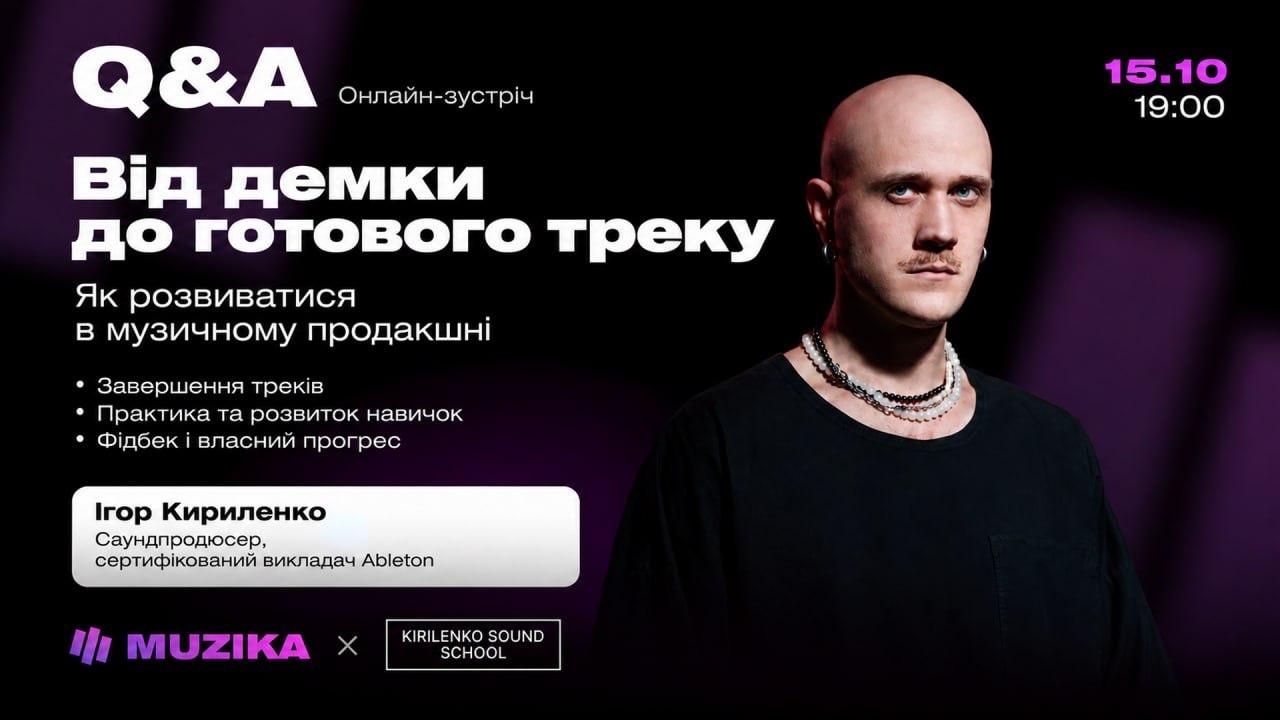
Ihor Kyrylenko, music producer, Ableton instructor, and founder of Kirilenko Sound School. Notes from the online meeting of 15.10.2026
Notes from the online meeting of 15.10.2026
Is there a “right” starting point, where to begin when you’re making your own sound without formal training and by ear?
It depends on what exactly you’re starting. If we’re talking about a track or a song, then everyone has their own starting point. Some people hum in the shower, some jot notes on their phone, some sit down with a guitar and hum something. But it still starts with some kind of idea.
His main advice here is simple: when making a demo, you need to let go of yourself. Don’t focus on making everything beautiful, clean, and expensive right away. When you’re making a demo, you need to give yourself room for imagination, for speed, for the idea itself. The sound can be “shit” — and that’s normal. First the concept is born, and only then is the form polished.
What immediately gives away a beginner in music production?
Ihor called this the beginner complex. That is, it’s not just about the sound, but about the whole approach: what the demo looks like, how it’s put together, how the person thinks about the track at all. An experienced musician already reads the form: where the verse is, where the chorus is, where the build-up should be, where the stronger moment should be. And a beginner often doesn’t even think in those blocks yet.
An important point: if you’ve been making music for a while, you can tell who made a demo just from the demo. Not by how “expensive” it is, but by how well the person understands the form and logic of the track.
What matters more in creating a track — technical skills or musical ear?
,Ear. Skills are secondary. If a person has a strong imagination, a strong idea, they will very often outplay all the technical guys.
If the song itself is good, people will listen to it even if the drums aren’t perfect or the sound isn’t fully “polished” yet. In other words, the idea is what matters most. Technique is important, but it doesn’t beat a living idea.
How do you know when to stop in arrangement or production?
The best way is to set yourself a deadline. Essentially, it’s a deliberate decision: by a certain day the track has to be finished, and after that you don’t touch it anymore. Because if you don’t consciously stop yourself, you can keep noodling on the track until you lose consciousness.
Ihor also added that what helps is not only a deadline, but also a clear sense of the goal. Just as a shooter imagines the bullseye and aims for it, in a track you need to see where you’re going: how the drums should sound, what the length should be, where the mood changes, where each transition is.
How do you find your unique sound and not get mixed up with what you’ve been listening to for years?
You are what you listen to. Everything a person has heard since childhood, all the films, music, discos, events, emotions — that is their inner baggage. Nothing comes out of a vacuum.
So uniqueness doesn’t need to be invented “from scratch.” It already exists in the mix of what’s in your head. Some people just need more time to put that combination together. And also — broaden your knowledge base, listen more, dive into different genres, including niche music. Because if you dig deeper, not just into the mainstream, your own decisions later on will look more interesting too.
Why is a demo written in a burst of inspiration often better than the final version?
Because the demo has life. And in the final version there’s often a balancing act: on one side — emotion and atmosphere, on the other — the urge to make it “right” and “high quality.” And that’s where you need to find the balance.
Ihor stressed: don’t overlisten to the demo to death. Don’t kill the atmosphere on the one hand, and on the other — don’t release something unfinished. With experience comes a sense of compromise. But the main thing is not to kill that first energy from which everything started.
What should you do if you feel stuck and need a break?
If there’s a deadline and nothing is ready, then of course you need to keep working. But in a normal situation, you shouldn’t torture yourself. Music is not something you should do with an overheated head.
Ihor says that even for his own head, it’s better when he gets proper rest. If he doesn’t open his laptop for two days, better ideas come afterward. That’s true. A rested mind always works better.
What is Ihor’s structure for working on a track?
Here Ihor didn’t give a universal recipe, because every case is different. And that’s very important: there is no single algorithm for all tracks. No matter what he says, it won’t be a rule for everyone.
But there is one overarching thing: look at the composition as a whole. Ihor even drew a parallel with directing. He studied stage and mass-event directing, so he thinks not in segments but in the big picture. What is the main idea? How does everything begin? Where does it lead? What should the listener be left with at the end?
How do you find strong transitions between a track’s structural parts?
According to Ihor, this is one of the weak spots for many people. And he recommends a very practical exercise: take 10–12 favorite tracks, listen to the transitions from verse to chorus or from one part to another, and write everything down on a piece of paper.
What’s happening there? Is there a stop-time? Does an instrument drop out? Does a new one come in? Is there a pause? Does the guitar keep playing? It’s these little details that build mastery. If you write them down by hand, you won’t forget them again.
How do you find a good mix engineer and give them a proper brief?
Very simply — know the terminology and speak specifically. Not “make it bang,” not “make it airy and transparent,” but exactly: what should happen with the vocals, where they should be louder, where quieter, what to do with the drums, what to do with the backing vocals.
Ihor emphasized: the more precisely the task is formulated, the closer you are to the truth. Because “make it cool” means nothing. But specifics give the person a chance to understand exactly what is being asked of them.
How should a beginner artist write a brief for a sound producer or recording engineer?
The same logic applies: you need to understand what you want. If you don’t understand it yourself, it’ll be easier to explain it to a tree than to a person. So first comes your own understanding of the task, and second comes clear language and specifics.
What’s the strategy after creating a track: go to a label or do it independently?
Here Ihor again comes back to the goal. What do you want from this track? Who are you right now — an artist, a sound producer, a DJ? Everything depends on that.
His position is this: a label is not just an office where tracks are uploaded. A label is a community. People moving in the same direction, sharing values, style, ideology, or at least a shared sense of music. If that resonates with you — great, join in.
How do you communicate with labels? By understanding what you actually need. And by having a clear sense that you’re not just throwing a track into the void somewhere, but entering a community where you have something to contribute.
What are the main mistakes beginner artists make?
The biggest one, according to Ihor, is striving for popularity as the goal. Because popularity is not a goal, but a consequence. If you don’t have a super-task, if you just want to “become famous,” then there’s no real foundation in that.
But if there is a task, a meaning, an inner reason — then the person becomes interesting to watch. And then popularity can come as a result, not as an end in itself.
What should you do if the track is already finished, but you still want to keep reworking it?
What should you do if the track is already finished, but you still want to keep reworking it? Release it and move on. Ihor said this very bluntly, but honestly: he himself has a lot of things he doesn’t know how to make shorter the way he wants. But there is a compromise, and it works.
In other words, the perfect track you’ll keep polishing forever is a trap. Better to finish it, release it, look at it from the outside, hear real feedback, and start the next one.
How do you find a balance between creative chaos and a normal work routine?
Creative people often don’t get anything done because they can’t organize themselves. That’s why balance is still necessary in life.
You can’t exist only in the mode of “I’m creative, I’m flying, I only create.” There’s a schedule, there’s work, there are other roles in life. And if you live in chaos all the time, there may be no result at all.
Can you be both experimental and understandable to the audience?
Yes, you can. Ihor doesn’t believe in the rigid opposition of “either format or experiment.” He gave many examples where tracks that initially seemed non-format later became strong releases and got a very good response.
His view: the concept of “format” often doesn’t exist at all. People who hide behind it often just don’t get it. Strong music may seem strange at first, but then break through precisely because it doesn’t sound like everything else.
How do you find clients and gigs as a producer?
You need to have a portfolio and not stay silent about yourself. One track is already a start. A playlist, Instagram, YouTube — everything where it’s visible that you know how to do it — that’s already the base.
And then — communication. Write to people, be in communities, offer your services, get to know people through friends, and collaborate with those doing similar things. All of this expands your chances.
Is it important which software you work in?
No, not critically. Ableton, FL Studio, Cubase, Reaper, Studio One — that’s not the point. The main thing is to understand the principle. The buttons are just in different places.
Does Ihor use artificial intelligence in his creative work? In the conversation he didn’t go into detail, but he made it clear that such tools exist and that the topic is familiar to him. However, the key decision in music still remains with the person.
What is the main takeaway from this meeting?
Don’t wait for the perfect moment. Make tracks. Set deadlines. Release. Analyze. Move on. Don’t chase popularity as an empty goal. Build your music as a system, not as a random burst of inspiration.
And one more important thing: your sound already lives in everything you’ve listened to before. The only question is how you gather it, live it through, and bring it into your track.
Author: Ihor Kyrylenko