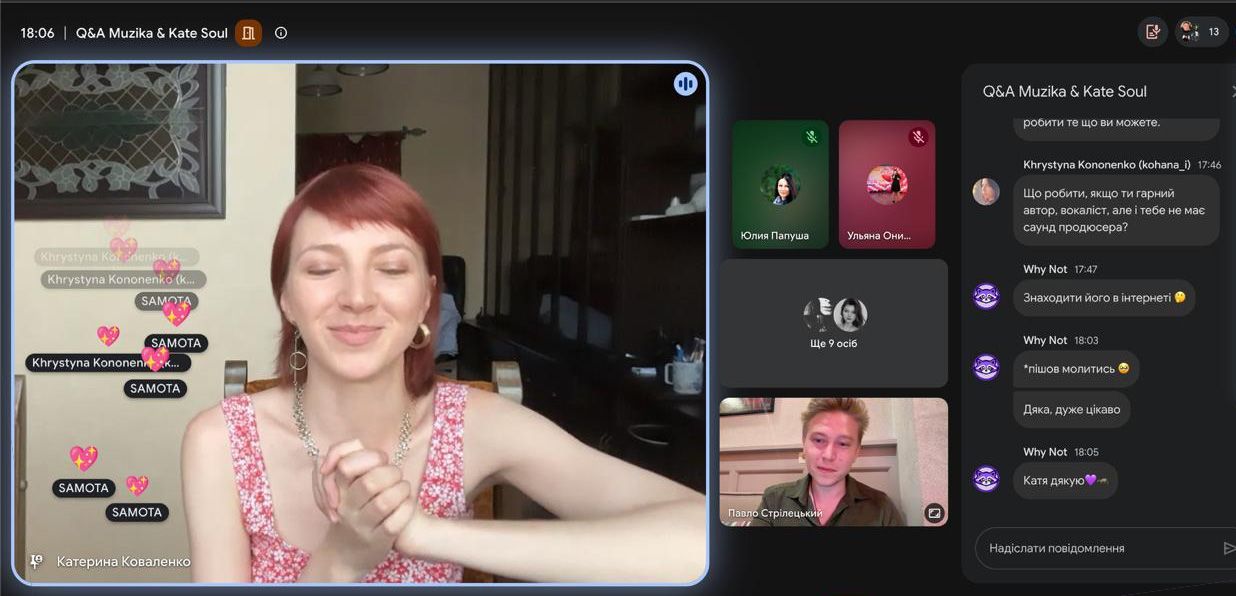
Q&A Artist Growth in 2026: notes from a meeting with Kate Soul
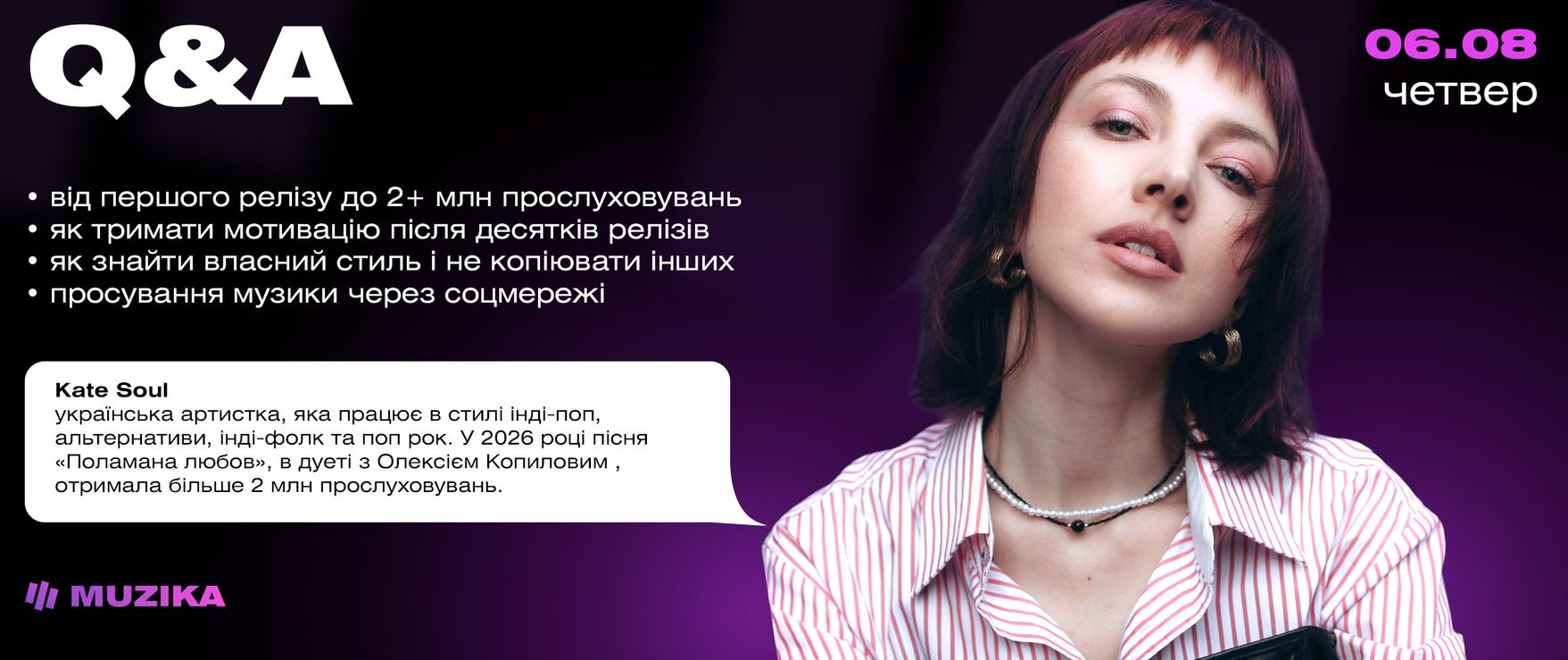
Kate Soul is a Ukrainian artist who has gone from bands and experimentation to a recognizable solo project. She works in the indie pop, alternative, indie folk, and pop rock genres, and her song “Broken Love” became a major case of organic growth: without a big budget, but with systematic work, regular content, and persistence.
Notes from the online meeting dated 06.08.2026
What did the artist start with?
Kate Soul began her musical journey back in 2012. Before her solo project, she went through several bands, worked in different formats, and later — abroad on the music project One Bad Planet.
Her start was nothing like an “ideal artist journey”:
- there were bands with different lineups;
- there was work in a group where there was not always enough room for her own voice;
- there were changes in style, language, and format;
- there was experience working in China on music contracts.
As a result, she moved to a solo format, in which she was able to gather all her sound into one cohesive story.
What stage is the Kate Soul project at now?
According to the artist, her project has finally become more clear and crystallized. She feels that acoustic sound reveals her best.
This is the stage when:
- the project has a more distinct style;
- the audience reads this format better;
- the artist is no longer scattering herself across random directions;
- there is more confidence in what exactly she wants to convey through music.
What challenges does an independent artist face?
The biggest difficulty she spoke about directly is money.
For an independent artist, a lack of budget affects everything:
- release frequency;
- production quality;
- promotion;
- team scaling;
- growth speed.
But at the same time, she emphasized that even without large funds you can keep moving if you have consistency, persistence, and a willingness to do a lot by hand.
What changed after the success of “Broken Love”?
After the track started taking off strongly, creative life changed noticeably.
There appeared:
- more attention from the audience;
- new collaboration inquiries;
- interest from brands;
- offers from labels;
- more visibility on streaming platforms and social media.
But an important nuance: the artist does not see this as automatically entering show business. She emphasizes that she remained independent and does not feel like part of the “scene” or the industry in the classic sense.
What realizations came after the track’s breakout?
One of the main realizations was very simple: if you don’t talk about yourself, no one will see you.
She recalled that earlier she used to be upset with the media and the industry because it seemed that a lot of work had gone into the release, but the result was small. But later she realized: she herself had done almost nothing for active promotion.
After that, the approach changed:
- they started shooting lots of videos;
- they started showing themselves regularly;
- they started using not just one channel, but several platforms at once;
- they stopped waiting for the song to “take off” on its own.
How can an artist find their style and not lose themselves?
Kate Soul does not talk about style as something chosen once and for all. Her path shows that style is formed gradually through attempts, giving up what is unnecessary, and returning to organic sound.
What helped her:
- listening to a large amount of music;
- experimenting;
- not getting fixated on one format;
- seeing where the sound feels natural;
- not trying to artificially become someone else.
How does Kate Soul write music?
There are several working formats:
- she writes on her own to guitar;
- sometimes she writes to piano;
- sometimes they finish tracks together;
- there are songs that Alexey finishes entirely;
- sometimes she gets stuck on a verse or chorus, and he helps put together the final form.
She also said that she is open to material from other songwriters, but the song still has to truly “fit” her repertoire.
How do you keep show business from changing you?
To this question Kate Soul answered quite directly: not trying to sell yourself at any cost.
According to her, attempts to artificially create a “hit” often do not work. If you start writing or looking the way you “should,” rather than the way you feel, your own potential gets lost.
What helps you stay yourself:
- not adapting to other people’s expectations;
- not making music “for the picture”;
- not chasing one format;
- not being ashamed of your own pace;
- not comparing yourself with everyone around you.
How much time passed before the first success?
If you count from the start of Kate Soul’s solo project in 2019, several years passed before the major breakthrough.
She does not call it a short path. On the contrary, she emphasizes that this is a long distance, where quick success is often the result of long and almost invisible work beforehand.
Were there doubts and disappointments?
Yes, and very strong ones.
She honestly said there were moments when it seemed that everything was standing still, while other people’s projects were moving faster. There were emotional setbacks, resentment toward the industry, and a sense of unfairness.
But it was exactly at that moment she did not stop — and that is probably one of the main reasons for her breakthrough.
What is an artist’s path without a producer and a large team?
Her case is essentially an example of an artist who for a long time relies on her own strength and on a very small circle of people.
What she showed:
- you can start without a large team;
- you can move forward through a partnership with one strong person;
- you can build a project step by step;
- first of all it is more important to find “your people” than just anyone.
When should you delegate? And how do you build a team?
In her view, you should delegate as soon as:
- there is already someone you can trust;
- there are people who truly share your vision;
- you feel that certain tasks are already taking too many resources.
Delegating does not mean “handing things over to just anyone.” She stressed that people need to be chosen very carefully.
You need to check people’s competencies, look at their background, and understand whether your values align.
She advises looking for people:
- through recommendations;
- through acquaintances;
- through social media;
- through the professional environment;
- through credits for favorite artists.
How does she promote her music?
The main focus is on social media and her own efforts.
At the center of promotion:
- TikTok;
- Reels;
- YouTube Shorts;
- regular video posting;
- homemade, live content;
- constant presence before and after release.
How do you deal with a situation where only 500 people see a song?
Make more content. She advises:
- don’t rely on one clip;
- don’t be afraid to post a lot;
- don’t wait for perfect delivery;
- test different formats;
- talk about the song not as a product, but as a story that people can see themselves in.
In her view, that is exactly what increases the chances that the song will find its audience.
How many videos should you shoot for one single?
Her advice is to shoot as many as possible.
In practice, that can mean:
- several videos a day;
- a stockpile of content in advance;
- regular posting before, during, and after the release;
- using several platforms in parallel.
She said outright that you should not wait for the perfect moment — you should just shoot and post.
How many TikTok videos were shot for “Polamana liubov” ?
She did not name an exact figure, but said there were a lot of videos.
And these were not professional, high-budget shoots at the start. On the contrary:
at first there were homemade recordings;
- a phone;
- a sofa;
- a guitar;
- live sound;
- minimal budget.
What drove the artist forward, even despite the genre’s lack of popularity?
She does not describe it as a conscious calculation on a trend. Rather — as a natural path back to herself.
Her music moved toward acoustic not because it was “trendy,” but because that turned out to be the most honest and accurate way to sound.
What was the budget for the video content?
For the first acoustic version of the song, the budget, she said, was zero.
They were able to make the content thanks to:
- their own initiative;
- willingness to shoot independently;
- the help of people who responded for free.
So the case of “Polamana liubov” is not a story about budgets, but about very strong inner motivation and consistent work.
Do you have any other ways of finding your audience besides viral content?
Yes. Kateryna noted that besides social media and viral videos, the following remain important live performances, street performances, and direct contact with people.
It is precisely such formats that can deliver not just an accidental view, but a more devoted listener who will remember the artist through live emotion.
Did you do pitching in Spotify for Artists, and how does it work?
Yes. Her approach is this:
- submit the track well in advance of release;
- understand that placement in playlists is not guaranteed;
- treat it as a normal tool, but not as the only promotion bet.
According to her, there is also a human factor there: a track may be chosen, or it may not.
How do you get on radio: is it free or does it cost money?
Kateryna said that radio is no longer the main benchmark for an artist today.
She emphasized the following:
- in the past, people often got on the radio for money;
- now radio no longer sets the rules the way it used to;
- audience reaction on TikTok and social media has a stronger impact;
- if a song really takes off with people, then radio may itself take notice.
How do you feel about targeting, and have you used paid advertising?
Kateryna said she tried paid promotion, but it did not become a decisive tool for her.
Her experience is this:
- targeting did not produce the same result as systematic organic work;
- often it just eats up the budget;
- real growth came not through ads, but through regular content and persistence.
Where do you get ideas for shoots and locations for videos?
She said that locations are often found very simply — through observation and improvisation.
Usually it works like this:
- they walk down the street and spot an interesting place;
- they immediately use it for shooting;
- if they work with videographers or photographers, those people can suggest even more options;
- sometimes a location is found by chance, with no preparation at all.
Can media and podcasts be used as a growth channel if there is still not that much material?
Katerina replied that media should not be put first, if there is still no strong musical foundation.
Her position is this:
first there must be material that speaks for the artist;
then podcasts, media, and other platforms may naturally gravitate toward it;
media visibility is not the starting point, but a consequence of already established interest.
The most important information voiced by Kate Soul during the meeting
The main growth channel — is systematic work, not random success
Katerina emphasized more than once that her breakthrough happened not because of one song or one clip, but because of daily and sustained work.
There’s no need to be shy about “annoying” your audience
Her position is very direct: if you want to be heard, you need to regularly show yourself and your music.
An ideal image is not as important as a live presence
She said outright that raw, honest, and homemade content works better than an overly polished image.
At the start, you can work with almost no budget
The first videos for “Polamana Liubov” were made without major expenses — on a phone, at home, on their own.
You need to find your own style, not invent it
In her view, style comes through listening to music, experimenting, and gradually returning to what sounds organic.
You have to write even without inspiration
Inspiration is not a reason not to work. Songs are born from discipline and regular practice as well.
Media, radio, and podcasts are not the main benchmark
She believes that first comes strong material and your own audience, and only then media visibility as a consequence.
The main thing is not to give up on the path too soon
Katerina said several times that every artist has their own time, and it is often endurance that decides everything.
Conclusion
The main lesson from this meeting is this: in 2026, an artist grows not when they wait for ideal conditions, but when they work systematically, are not afraid to show themselves, and do not betray their sound.
Kate Soul’s story is an example of how an independent artist can grow without a big team, without constant investment in PR, and without trying to please everyone.
Guest: Kate Soul