Independent Artist Promotion: How to Make Money from Music
INDEPENDENT ARTIST PROMOTION
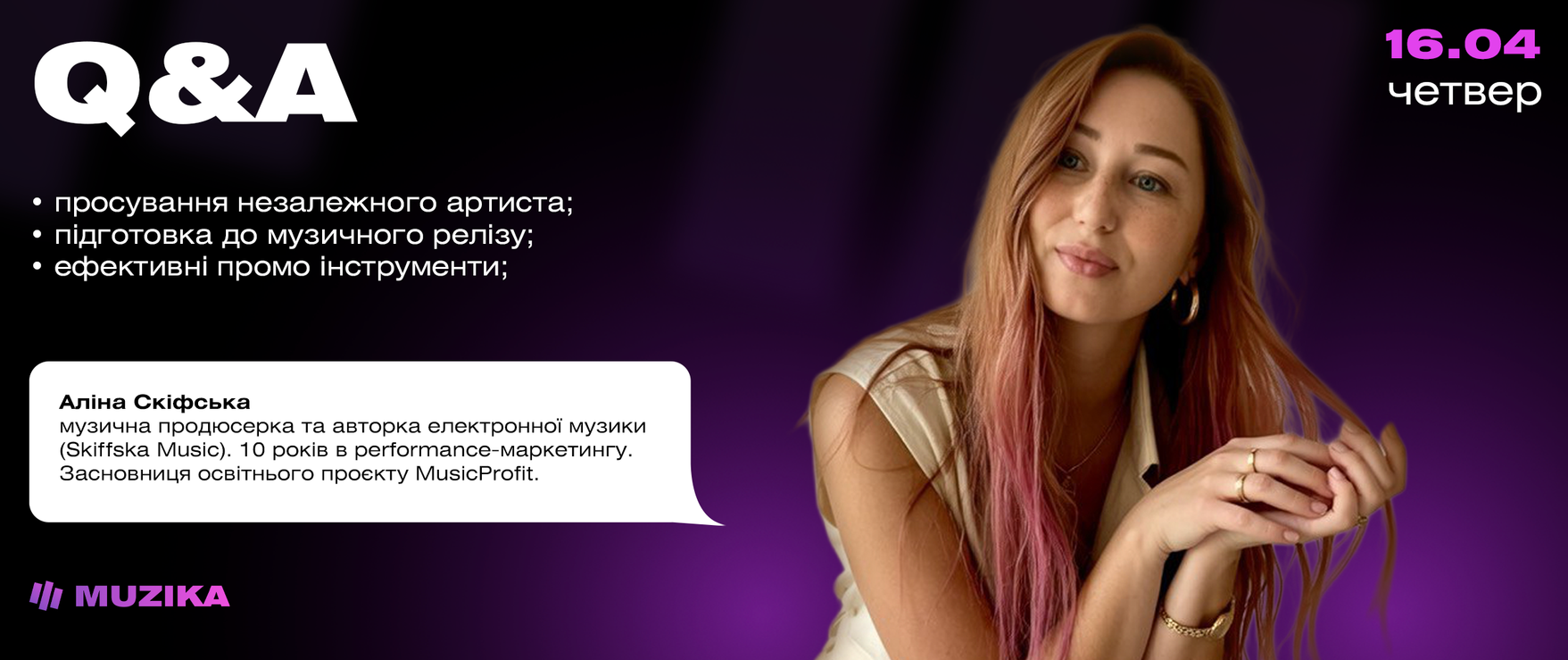
Alina Skifska – Ukrainian music producer and electronic music artist (Skiffska Music). 10 years in performance marketing.
Summary of the online meeting from 16.04.2026
What to consider a minimum budget and how to launch a release
Practical benchmark: the minimum budget for promoting a first release is approximately USD 50–100. This budget is enough for an initial hypothesis check, curator playlist submissions, local media/radio, and basic testing, not for a large-scale campaign.
It is important to understand that for a young artist, the first releases are primarily about collecting data: what reactions the audience gives, which channels work, where there are listens and saves, and where there are none. Based on this data, subsequent releases can be amplified with a larger budget rather than spending money at random.
Organic promotion and release preparation
For organic growth, the key is pre-release preparation: communicating with a warm audience, collecting pre-saves, and activating listeners before the song comes out. The optimal preparation period is roughly 3–4 weeks before release, so there is enough time to gather pre-saves, prepare content, and give algorithms their first signals within the 24–48 hour window after release.
Among the important organic actions:
- active communication with friends, colleagues, acquaintances, and the music community;
- invitations to pre-save;
- regular posts that drive streams;
- replying to comments and maintaining dialogue with the audience;
- using emotion and creativity in communication, not dry calls to action.
It was separately emphasized that music marketing is not only about “emotion” but also about a network of mutual connections: reposts, thanking curators, personalized communication, and building trust.
Testing a track before release
Testing is not about “like / dislike” but about checking specific signals:
- retention in video (whether the video “drops off” in the first 3–7 seconds);
- watch depth;
- saves;
- comments and emotional response;
- audience behavior in a warm community (Telegram, friends, acquaintances);
- reaction from a genre audience through services like Submithub Hot or Not.
The effective testing methods named were:
- short clips on TikTok and Instagram with different visual contexts;
- testing with a warm audience on Telegram;
- feedback from genre listeners on Submithub;
- live performances and even street/offline tests, if the artist performs live.
For testing, positive feedback is not the only thing that matters — a negative reaction is also a valuable signal about what exactly is triggering attention.
Content and video strategy for a release
There was a lot of focus on content, but with an important caveat: 2–3 videos are critically too few if the artist wants to tune the algorithms and test the “sound + format” pairing. It is important to make series, work with one content direction long enough, and not post random clips on different topics.
Among the workable approaches to video:
- people’s reactions to the song;
- lip-syncs in unconventional looks;
- emotional videos after recording the track;
- movement in frame, an anomaly, or an unexpected element at the start;
- unconventional visual context, symmetry/asymmetry, striking locations;
- live footage from rehearsals, the studio, street performances.
For artists who do not want to do classic lip-syncs, other formats were suggested: reactions from friends/relatives, stage fragments, live emotional responses, videos with movement and a strong visual hook.
It is worth understanding that platforms benefit from keeping users on the platform, so redirecting people to a profile bio is not always welcomed by the social networks themselves.
As an alternative:
- comment mechanics followed by an automated DM;
- added value behind the link (behind the scenes, closed channel, bonus content);
- story chains saved in highlights;
- direct or automated replies via Meta in Direct.
What works and what does not work in 2026 when promoting a release
Tools considered weak or harmful:
- bot-driven stream and follower boosting;
- paid guaranteed playlist placements without quality verification;
- direct targeting to Spotify for weak material;
- high-frequency hashtags on Instagram without a strategy;
- impersonal mass press releases;
- overly frequent releases without preparation;
- chaotic content without focus.
Instead, the following were named as working tools:
- pre-save;
- personalized pitching;
- curator playlists by genre;
- UGC integrations;
- video content with a strong hook;
- regular interaction with the audience;
- organic building of loyalty.
Playlists, curators, and quality checks
They explained who a curator is: this is the person who assembles playlists and decides whether a track gets included. For checking playlists for bot activity, they mentioned Artist Tools and Submithub, as well as manual verification through the profiles of the artists in the playlist and the Discovered on section on streaming services.
It was noted that if a playlist is artificially generated, it can harm the artist — so before paying, you should check:
- whether there are real artists in the playlist;
- whether the audience is similar;
- whether there is an overlap in genre and vibe;
- whether other artists mention this playlist in their analytics.
They separately discussed that outreach to curator playlists only makes sense when the genre, audience, and playlist all match. Otherwise, it is a waste of budget with no result.
Copyright, Content ID and piracy
When releasing music, you should not forget about copyright:
- registration with collective management organizations;
- registering the track in the Content ID system through the distributor.
Their position on pirate channels and Telegram playlists was negative: they do not provide the artist with normal income, do not drive audiences to streaming services, and create a habit of consuming music without paying. It was proposed to fight this primarily through educational work with listeners and by popularizing official services.
Listener funnel and audience core
The classic artist funnel:
- Awareness — a person sees the artist for the first time.
- Attention — starts following, subscribes, returns to the content.
- Engagement — comments, shares, listens on streaming services, interacts.
- Loyalty / advocacy — becomes the core audience, comes to concerts, buys merch, supports financially, recommends the artist to others.
The core is not bought directly through advertising — it is built through the artist’s personality, the material, and systematic communication.
Ukraine vs. the European market
In the conversation, it was emphasized that the Ukrainian market is still developing and does not yet have enough genre infrastructure: there are not enough niche playlist curators, local genre media, or structured playlists for specific styles.
For the European market, it is important to take into account that:
- different genres have different geographic points of strength;
- what works better in Berlin may not work in Ukraine;
- promoting in several markets requires multiplying the budget, time, and tasks;
- genre and location specifics affect the strategy.
How do you check a playlist for bot activity?
- look at which artists are on it;
- check whether they are active and real;
- look at the Discovered on section on streaming services for the artists from this playlist;
- use services such as Artist Tools and Submithub.
Is it worth paying to get onto curator playlists?
Only if the playlist is truly relevant to the genre and audience. If not, it is a waste of budget.
Are Groover / Submithub relevant for Ukrainian-language music?
Yes, but it depends on the genre and the goal.
Submithub is also suitable for Ukrainian-language music — there are Ukrainian-language playlists there, but you need to search by genre.
Groover can be used as a tool for going abroad, including for local radio stations.
For a Ukrainian release, this can work if there is a clear genre fit and the right curator.
Is there any point in paying to get onto curator playlists, for example Culture Ukraine?
Sometimes yes, but not automatically.
You need to see whether the playlist fits the genre.
It is important to check whether it has a real audience, not bots.
If the playlist is actually listened to and it matches your genre, then it may make sense.
If not, it is just money wasted.
Can you use covers if you want to position yourself as an artist?
You can, but Alina does not really recommend this as a main strategy.
Covers engage the audience more with someone else’s song than with your own artist name.
If it is an authorial reinterpretation, then it is closer to a creative format.
How do you start if you only have rough demos?
Alina said that this is already enough to start testing.
You can cut up demo fragments;
upload them to TikTok / Instagram;
see the reaction;
check which pieces work better.
So you do not need to wait for the perfect release — you can start with tests.
What should an artist do without live performances if the genre is metal / ambient / instrumental?
Alina advised:
- do live streams;
- show the music creation process;
- use the live performance format in the studio or at home;
- for heavy music — work through energy, stage presence, live visuals.
Pavlo added ideas about:
- filming at rehearsals;
- live performances in unusual locations;
- short promo clips with stage energy.
Final recommendations
The meeting arrived at several key points:
- do not expect that “good music will find listeners on its own”;
- test releases before they come out;
- make regular, but not too frequent, releases;
- focus on focused content, not chaos;
- work with a warm audience before the release;
- build streams, not pirated workaround channels;
- check playlists, curators, and channels for real quality;
- do not ignore copyright registrations;
- A release is part of a long-term system, not a one-off campaign.
Author: Alina Skiffska