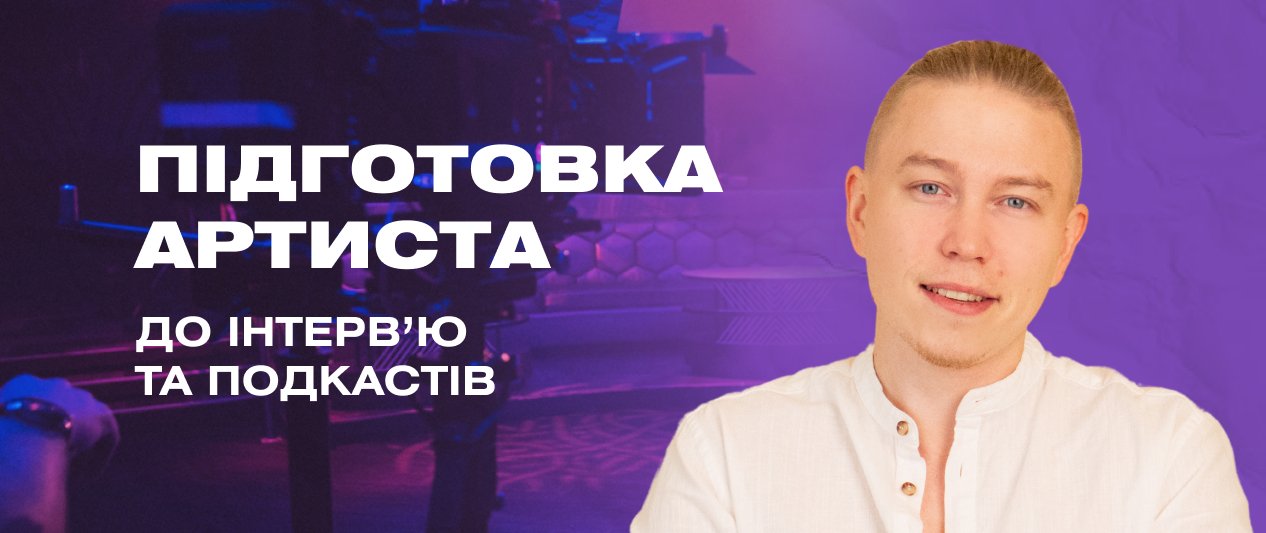
Artist Preparation for Interviews and Podcasts
Let’s imagine a situation where an artist is invited to an interview. What should they do next? Is it enough just to show up looking good and on time at the location?
Answering
An interview is an opportunity to exclusively provide information that is important to the artist. To present themselves, their position on certain events, to reveal their own philosophy and worldview, to announce key news relevant to their career. So there must be a clear understanding of what to talk about, what to prepare, and to PREPARE it, to work through reactions to different possible scenarios, to announce such media appearances to your audience in advance, to create intrigue among your fans, and so on. After all, the task of attracting attention is not easy for everyone right away, and that is normal.
Of course, only in practice can you fully understand your weak and strong sides so that next time you will be better prepared. But speaking from experience, few independent artists think about the need to prepare for interaction with media appearances, and as a result they get less effective outcomes and, probably, even lose journalists’ interest in speaking with such an artist again.
Not everyone, but a large number of artists have to be ready for a wide range of media activities in order to effectively promote their own brand, attract new audiences, and retain the attention of the existing one.
In this article I will reveal the key aspects of preparing an artist for media appearances. You will learn how to prepare effectively for interviews and podcasts, what steps need to be taken for a successful appearance in front of the camera and audience, as well as how to build effective relationships with journalists, the production crew, and other team members.
May this article help you find inner confidence, calm you down, and prepare you for a high-quality media appearance that you will enjoy yourself and from which you will achieve your goals. Let’s begin!
Section 1. What purpose can an artist use media appearances for?
First of all, for building a personal brand or image around oneself.
Exactly, simply through conversation we immediately form an impression of ourselves. For this we have such tools as:
The artist’s tone of voice can tell you a lot. For example, a soft, confident, deep male voice can create an impression of wisdom and reliability, while a more energetic or passionate tone can emphasize the artist’s emotionality and passion for life.
Depth of thought: the artist’s ability to express deep thoughts and ideas can make them more attractive to the audience, increasing their authority as a creator. Although again, on the other hand, if boundaries are not respected, it may make the artist seem boring, and listening will be uninteresting instead. But the ability to speak interestingly on many different topics can make a good impression of a versatile personality.
The presence of jokes and humor: within appropriate limits, this can create an image of the artist as open, friendly, and welcoming. The ability to connect with an audience through humor can help the artist become more appealing and memorable to listeners.
By the way, vulnerability can reveal an artist very interestingly vulnerability. We are afraid to be vulnerable and share failures or stories that reveal us, at first glance, from a negative side. Although, in fact, it shows that we are living people and that in our lives there is not only “successful success.”
These and other tools should be used individually, taking into account the specifics of the project itself. BUT! Be sincere, be genuine, you do not need to prove anything to anyone. Being yourself is difficult, harder than seeming “perfect,” but it truly commands respect.
The purpose of a media appearance is to inform and draw attention to the news hook.
Guest streams, podcasts, and interviews can be used to communicate with audiences about important events that have happened or are approaching.
Promotion of music releases: media appearances can be used to promote new singles, albums, or music videos.
Support for tours and concerts: media appearances can be used to promote upcoming concerts, tours, and other events.
Major news hooks: winning or participating in national or international competitions, receiving grants, implementing or promoting projects, collaborations with other artists.
Audience engagement and communication with it: media appearances can help an artist interact with an existing audience or attract a new one, communicate with it, and involve it in their creative processes. Although this should not be set as a goal, rather as a consequence.
Building a media interaction history, establishing contact with journalists or editors: media appearances can be used to build relationships between the artist and specific media outlets, as well as attract the attention of others. Having journalist friends in your network is useful. This can help at important moments in a career.
Section 2. Preparing for an interview.
During a live broadcast there is no “take 2,” and in a face-to-face conversation with a journalist, everything the artist says can be used against them. Therefore, an interview is not the place for pure improvisation. There are basic things that need to be prepared so as not to lose the opportunity to discuss what matters and to avoid tangential topics well.
1. First, research the media platform:
Before going for an interview, it is important to familiarize yourself with the media outlet and the journalists conducting the interview. Understanding their audience, style, and topics will help you prepare to discuss relevant subjects and identify your key messages. By reviewing and analyzing previous interviews, you can understand the style of conversation, how far the journalist may go, and so on.
2. Formulating key messages:
Before the interview, define the main messages or ideas you want to convey. This could be your origin story, a major change in the team by another member, filming a music video, a fundraiser for the Armed Forces of Ukraine, or any other aspect of your career or творчість. Formulate them clearly and specifically so that they are easily understood by the audience.
3. Practicing answers to common questions:
Prepare answers to common questions that may be asked during an interview. The most typical questions for a beginner artist (or a beginner journalist) are about a stage name or the title of a song, music style, the ideas behind a song’s lyrics or how you create music, future plans, where you draw inspiration, why you chose the path of a musician, and what your mission is, etc. Practice will help you answer confidently and provide clear, specific answers. These are exactly the kinds of questions that do not require long discussions or vague, watery theses. Our airtime is limited, so it is better to use it in an interesting and productive way.
4. Perception of your public image:
Before an interview, it is important to understand what kind of public image you want to create and how you want to be perceived in the eyes / little ears of the audience. “I want to be myself” is a lazy answer, although it is important. Ask yourself: what kind of artist am I? What do I bring to the masses? What behavior is acceptable for me, and what is the opposite? What emotion do I want to convey through my work? By giving real answers to these questions, you will form a vision that may include clothing style, body language, tone of voice, and the overall atmosphere of the interview.
5. Camera practice:
If the interview is in video format, I recommend working on camera beforehand, and more than once, to understand how you look and how you behave during communication. You can notice a lot of interesting things — I know from my own experience. This will help you feel yourself, understand your strengths and weaknesses, adjust your behavior, and thereby feel more comfortable and confident during the actual interview.
6. Taking technical details into account:
Before the interview, make sure you understand all the technical details, such as the time, place, duration, and format of the conversation. Proper preparation of the technical aspects will help avoid unnecessary stress and allow you to focus on the content.
Taking these tips into account and preparing properly, you will be ready for an effective interview that will help attract the audience’s attention and raise your media profile.
And also, don’t be upset if, when listening back to the interview, you hear filler sounds or words like “uhhh,” “like,” etc. Not everyone is born an eloquent speaker, but this can be achieved with practice and self-improvement. To calm yourself further, you can watch the first interviews of famous artists from before they became famous.
Section 3. Preparing for a podcast.
Participating in podcasts is an interesting opportunity to talk for longer, about something specific or about several topics. It is also a way to shape your image and share information about yourself and your work with a listening audience. By the way, truly great episodes people recommend to each other like books, so this word of mouth can organically bring in an audience. However, for that to happen, before appearing on a podcast, you should prepare and ensure high-quality, effective communication.
1. Research the podcast
Before taking part in a specific podcast, it is important to familiarize yourself with its format, themes, and hosting style. Listen to a few episodes of that podcast, as well as podcasts with other guests, to get a sense of its atmosphere and specifics.
2. Get to grips with the topic
Before appearing on a podcast, reread / review information on the podcast topic. It is also great to understand it from different angles. For example, the topic is “royalties.” Several parties are involved in royalties, not just the distributor and the author, so you will be much more constructive and in-depth if you look for information on royalties from music producers, labels, streaming platforms, etc. Each of them sees the topic from their own perspective. So it will be useful even for you to better understand such a process in the market.
3. Rehearse the appearance
Depending on the podcast topic, you can practice before the recording itself. Play role-playing games with yourself, imagining what questions may come up, and discuss them from as many different angles as possible. At first, your brain may resist this approach, but after a few minutes you will get into the groove and may even like the format.
4. Be ready to communicate
During your participation in the podcast, be open to communication and exchanging opinions with the host and other participants. Treat it as an opportunity to share your experience and reflections with the audience.
5. Show your personality
Remember that one of the goals of participating in a podcast is to build a personal connection with the audience. Be open and authentic, show your unique personality and attitude toward the topics being discussed; after all, it is not always about music. When asked a question you do not want to answer, you have the right not to! If you are not familiar with the topic, you can say so, for example: “I haven’t explored this issue deeply yet, but I can share my own view.”
It is better to say little and to the point than a lot of nonsense. The audience will appreciate it.
Author: Pavlo Striletskyi
Author: Pavlo Striletskyi