Independent Music 2026: The Battle for Music Infrastructure
STVDIO report in partnership with Secretly Distribution
In 2026, the independent music catalog is thriving. Today the independent sector accounts for:
46.7% of the global recorded music market share;
35% of music streaming consumption;
40% of global album sales.
However, a very different process is unfolding beneath the surface. Music-industry infrastructure is quietly consolidating: traditional independent roots are being uprooted and replaced by major-label channels and “pipes” at nearly every level of the system, while artificial intelligence is preparing to rewrite the next royalty model. The independent sector’s biggest battle in 2026 has shifted into the operational arena.
2026 became a critical moment in the struggle for independent infrastructure across the board: from music creation and distribution tools to AI licensing, streaming services, and direct communication with fans.
Where is the risk? And where is the opportunity?
As of mid-2026, this is most clearly reflected in three areas:
Distribution (Section 1): A wave of acquisitions has moved another portion of independent distributors under the control of major labels and private equity funds.
Risk level: High.
AI licensing (Section 2): AI licensing is the next critically important music infrastructure. Major labels and Big Tech are trying to impose their own rules of the game, but the independent sector has a chance to seize the lead while court battles continue.
Risk level: Medium.
Opportunity level: High.
The strength of independent collectives and new models (Section 3): Collective organizations such as Merlin, IMPALA, ORCA, and WIN are operating faster and more effectively than ever. There are also major opportunities in niche streaming models, emerging markets, and tools for direct ownership of your own audience.
Opportunity level: High.
Section 1: The erosion of independent distribution
2026 became the year when the concept of an “independent” release was finally blurred beyond recognition. A musician may fully own their catalog and position themselves as a fierce indie artist, while every one of their uploads, royalty payments, and metadata lines passes through major-label systems—and the artist may not even realize it.
Over the past ten years, the Big Three majors have systematically bought up distribution platforms, while the influx of private capital has only intensified asset concentration. The culmination came at the beginning of 2026:
Universal Music Group completed its acquisition of Downtown Music for $775 million, bringing independent distributors such as FUGA, CD Baby, Songtrust, AdRev, DashGo, and Sounddropunder its control.
Warner Music Group acquired Revelator — a white-label distribution and royalty-management platform used by hundreds of indie labels, distributors, and rights holders.
DistroKid was sold for a record $2 billion to the private investment group CVC Capital Partners, putting the data of more than 2 million artists and roughly 30–40% of all new global releases into the hands of financial investors.
Distributor Too Lost raised nine-figure investment from private equity funds.
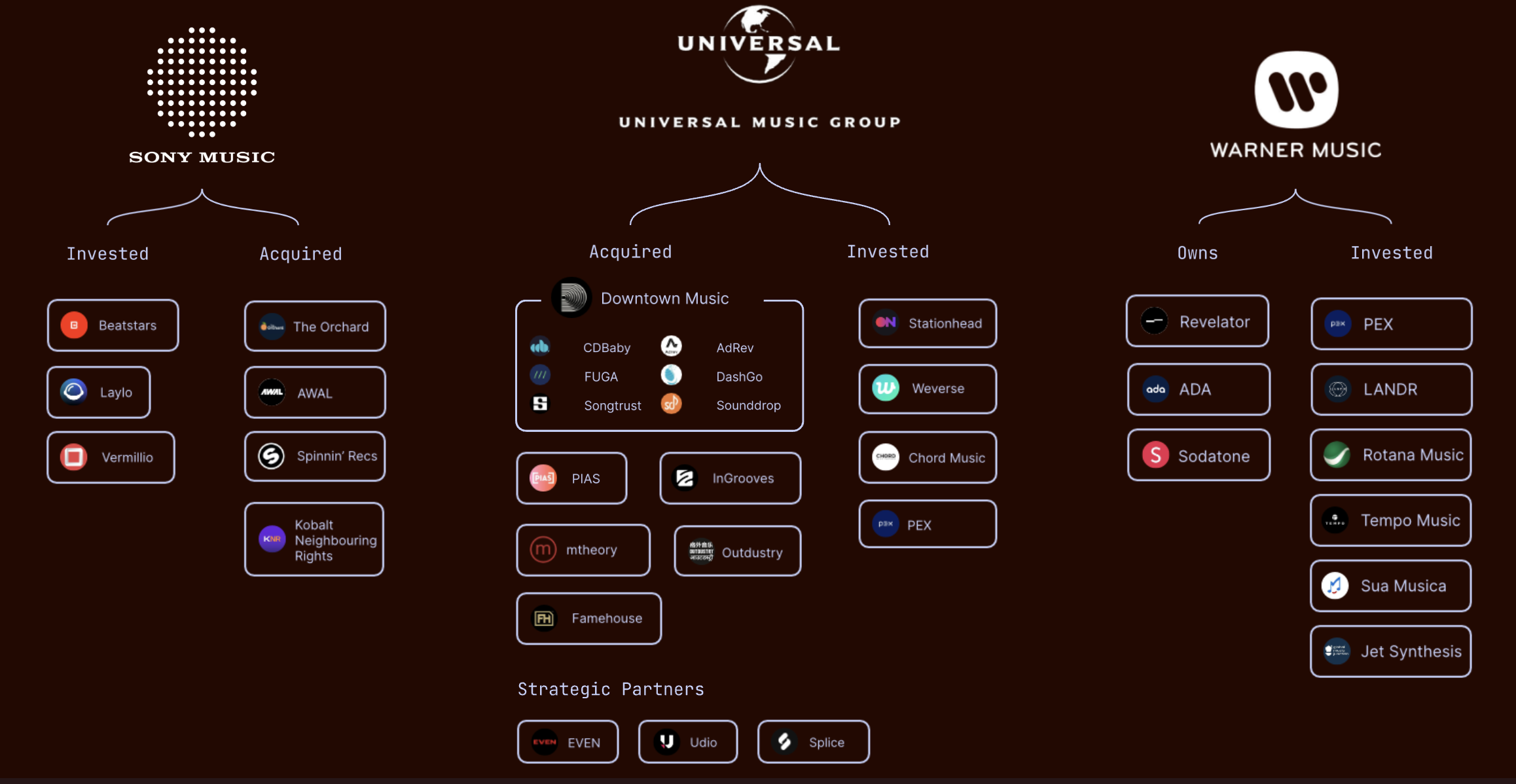
(The majors also acquired stakes in or formed strategic partnerships with Beatstars, Laylo, Vermillio, Stationhead, Weverse, LANDR, Splice, Udio, PEX, EVEN, and others.)
“When the biggest players become too big, the market becomes overly concentrated, and the openness and viability of the entire music-creation ecosystem come under direct threat — especially when giants gain leverage that allows them to rewrite the rules for the rest of the market.”
— Darius Van Arman, Secretly Distribution
Why this is happening: Leverage, Data, and AI
Distribution consolidation gives the majors four strategic advantages at once:
Leverage over streaming platforms (DSPs): In the early days of streaming, the majors had absolute influence over Spotify thanks to their catalogs. As the platforms themselves grew more powerful, this catalog-only influence began to weaken. By controlling the delivery channels through which 30–40% of “indie releases” and a large share of listens flow, corporations are regaining the bargaining power they lost.
Deal data and insights: Access to internal dashboards, financial reporting, and third-party analytics gives the majors a complete view of the market: they obtain detailed data on payouts, contract terms, and listening patterns for hundreds of thousands of third-party artists, writers, and labels.
AI positioning: Whoever controls distribution channels holds all the technical keys to the future of AI licensing: metadata standards, attribution systems, opt-in consent capture, and settlement gateways. AI labs do not need to license all the music in the world at once, so the winner here is the one who closes the deals first (such as Warner Music’s settlement with Suno).
Investor predictability: Unlike the unpredictable business of breaking new hits, acquired platforms and services generate stable recurring subscription revenue, showing public investors a resilient, diversified model.
The list of truly independent distributors keeps shrinking: among the remaining independent B2B partners are Secretly Distribution, State51 Conspiracy, EMPIRE, IDOL, Proper, AudioSalad, Cargo Independent Distribution, Stem, Edel/Kontor, Amped/Alliance, and RedEye/Exceleration. Among self-serve services, TuneCore (owned by Believe), ONErpm, RouteNote, Symphonic, Seed Worldwide, and Ditto.
True independence in 2026 is defined less by who is named on the copyright and more by who owns the infrastructure, technical tools, and leverage.
Section 2: AI Opportunities for the Independent Sector
20 years ago, Spotify and the major labels made backroom deals that defined the economics of the music business for an entire generation and left the independent sector with unfavorable financial terms. Today, the situation risks repeating itself.
AI licensing is becoming the next critical layer of infrastructure. Artificial intelligence is becoming an inseparable part of creativity in DAWs, songwriting, sync, and remixing — up to 90% of musicians are already using these technologies.
(Source: STVDIO x SD)
Why both extreme scenarios are harmful
The industry has split between two extremes, and both pose a threat to the market:
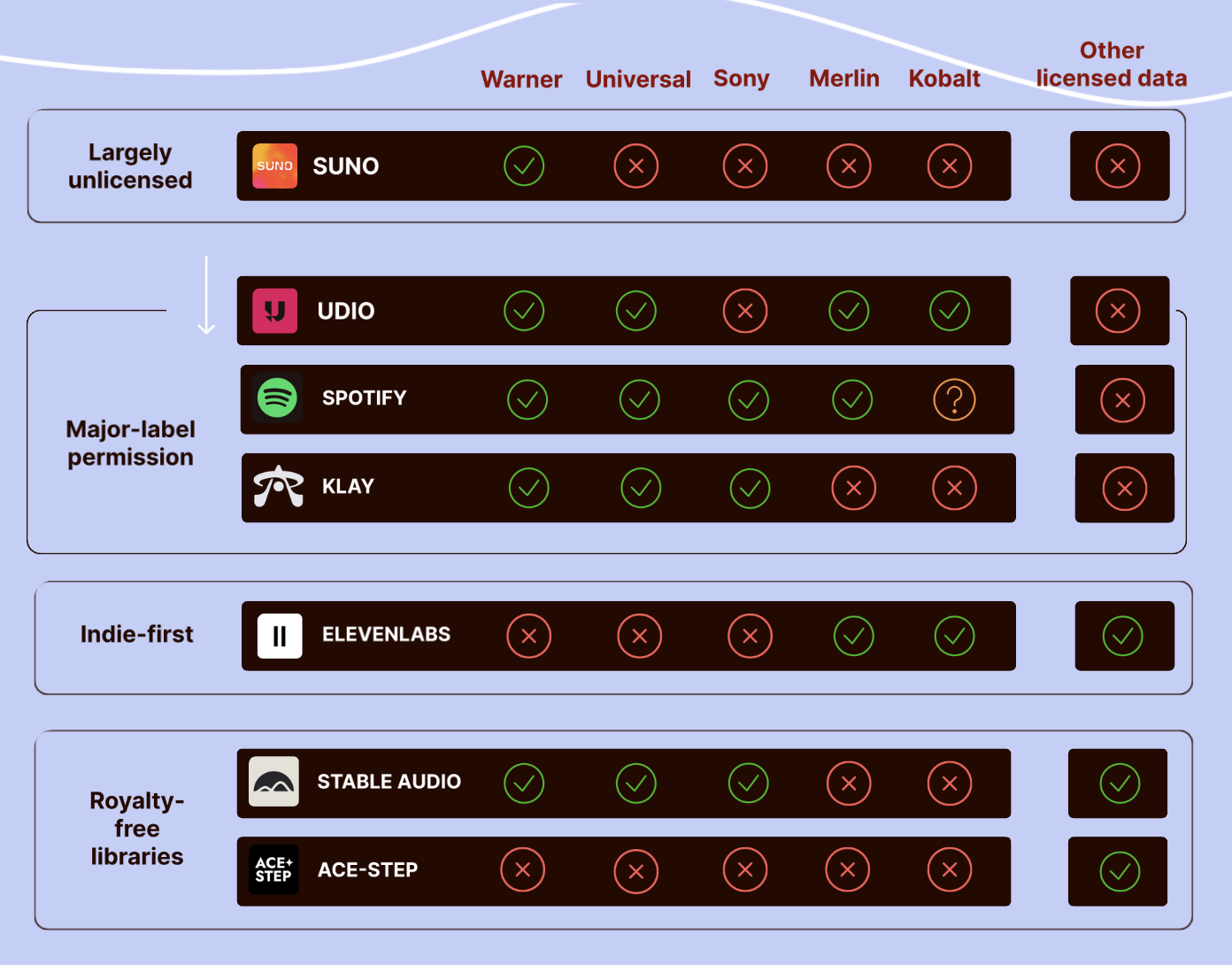
Unlicensed “Fair Use” model (Suno): If the court upholds the right to train neural networks on other people’s catalogs without licenses, artists’ work will be devalued: creations will be fed to models without payment or attribution.
Major-label “walled garden” model (Udio): After the claims were settled, Udio turned into an isolated remix platform from which it is impossible to export the music created there. Udio’s website traffic fell by more than 60%, pushing users toward unlicensed services. In addition, royalties in such remix models go only to the artist whose track was reworked, not to the writers or producers whose original sounds and drum parts were used to train the algorithm. All the money is once again concentrated around pop stars.
Independent compromise: the way forward
The independent sector, led by Merlin , is advocating transparent, licensed, and ethical models built on respect for people and authors’ consent.
A notable precedent was set by ElevenLabs, which introduced a model based on agreements with Merlin and the publishing company Kobalt:
Participation is fully voluntary (opt-in): artists themselves agree to train the algorithms and receive a share of the revenue.
The model is licensed, free of lawsuits, and open to developers of new application tools (for example, MozartAI for DAWs or vocal-processing systems).
Kobalt secured a clause in the contract on “most favored nation” status (Most Favored Nation): if the major labels later negotiate better terms, the rate for Kobalt automatically increases.
Three questions remain open for now: attribution (how to measure a specific catalog’s contribution to generation), catalog coverage (at Secretly Distribution, out of more than 100 labels, only three labels and seven artists agreed to opt in) and royalty size (minimum-rate standards are still being formed).
The independent sector faces a choice: either join in shaping the technology and tune it to its own advantage, or take the role of observer and once again allow tech giants and major labels to set unfavorable financial rules for the next two decades.
Section 3: The Power of Independent Alliances and New Models
Despite the risks of distribution monopolization and the challenges in AI, 2026 is seeing four points of leverage where the independent sector is increasing its influence:
1. Strength in unity and collective investment
Trade organizations and associations are acting in a coordinated and rapid manner:
Merlin not only struck the first major deal with ElevenLabs in late 2025, but also signed an agreement with Udio in January 2026.
ORCA alliance: 24 independent labels joined forces to co-invest in the launch of a new streaming service Cantilever.
Protection of royalty systems: Merlin, together with Jamen Capital, acquired the platform Curve Royalty Systems, safeguarding its independence.
Futures Music Group: A collective of independent labels raised $6 million to invest in artists and infrastructure startups (Splice, Indify, ITM).
Secretly Distribution: They acquired the data-processing service BabelOps to strengthen information security.
IMPALA: The European association of independent companies unveiled a new project to reform streaming in defense of independent rights.
2. New niche streaming platforms
As the industry approaches the 1 billion subscriber mark, demand for specialized services is growing:
Qobuz: Hi-Res streaming surpassed 1.2 million active users per month, and subscription revenue in 2025 grew by 45% (growth 4 times faster than Spotify’s).
Cantilever: A streaming app exclusively with an independent catalog, without major players. The service offers about 10 curated albums per month on a rotating basis: each release takes turns appearing at the top of the homepage, eliminating the algorithmic “winner takes all” principle. Royalties are paid under a user-centric model (the user’s money is distributed solely among the albums they actually listened to). The project has been supported by Domino, Sub Pop, Secretly Group, and Ninja Tune.
Audiomack: Became the leading app on iOS and Android in Nigeria, amassing more than 58 billion Afrobeats streams thanks to accounting for local conditions (daily and weekly Audiomack+ passes, integration with local operators, and 1.9 billion offline downloads).
Alongside them, genre-specific platforms are growing: Beatport (electronic music), Idagio (classical music) and Nugs (live concert streams).
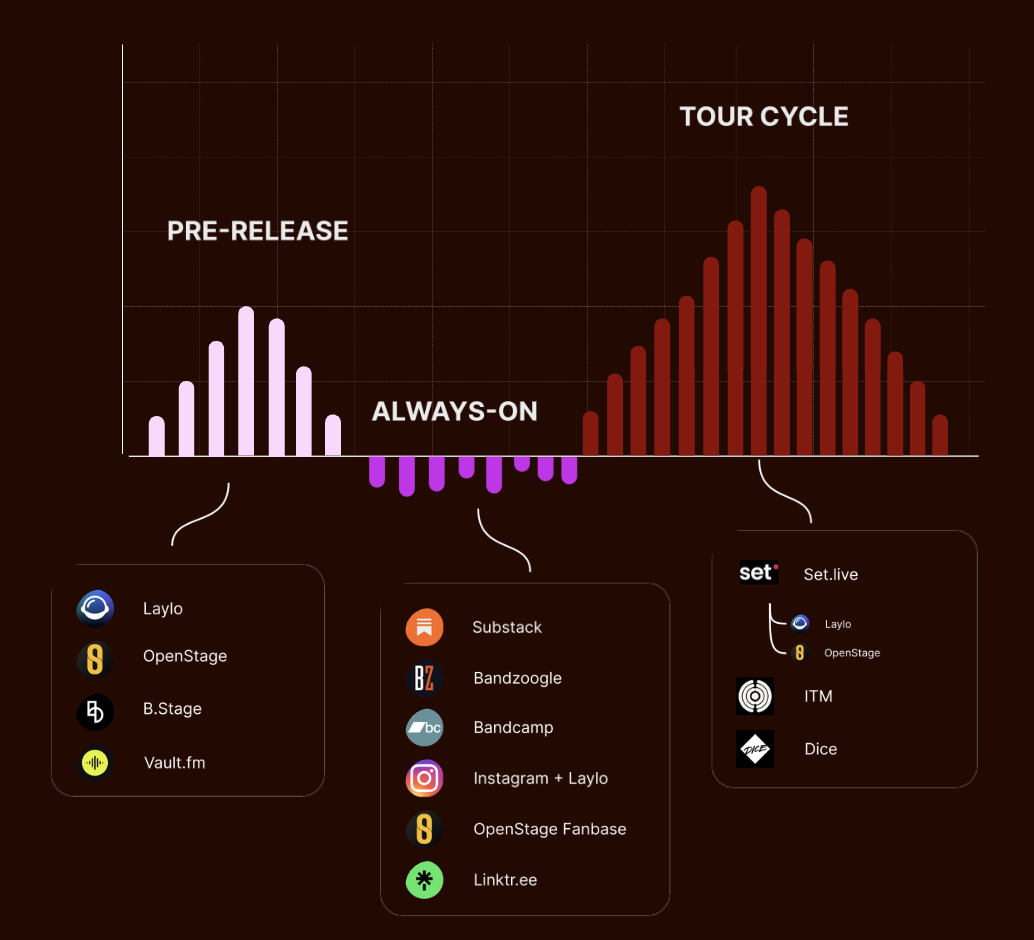
3. Direct Ownership of Your Audience (Owning Your Audience)
Collecting direct fan data has ceased to be a theoretical concept and has begun to work at a systemic level:
Mitski moved more than 200,000 fans into her personal e-mail mailing list through tour announcements on Instagram.
Japanese Breakfast collected hundreds of direct phone numbers every night during shows through QR codes in venues.
JVKE engaged more than 200,000 users in its mailing list through a page for an exclusive first listen to a song.
BLOND:ISH transformed tens of thousands of social-media followers into a personal contact database.
(Source: STVDIO x SD)
4. Emerging Markets
4 out of 5 new streaming subscribers come from outside the United States and Europe: Latin America, the Middle East, North Africa, and Sub-Saharan Africa are growing rapidly (Afrobeats streams from 2017 to 2022 grew by more than 500%).
At the same time, growth in Western countries is slowing: the share of North America and Europe in global subscriber volume fell to 41% in 2024 (compared with 52.3% in 2020 and 62% in 2015), while paid subscription penetration in the United Kingdom has stalled at 48%. Independent teams have an advantage in speed and flexibility, working directly with local managers who independently develop artists on the ground.
Independent music is a commitment to diverse, bold, and uncompromising art that protects culture from blanket homogenization. The same applies to infrastructure: the industry urgently needs independent delivery channels and transparent licensing models.
Despite market concentration in the hands of major labels and private capital, the unified independent sector in 2026 has enough strength and resources to defend its infrastructure space and lead change.